
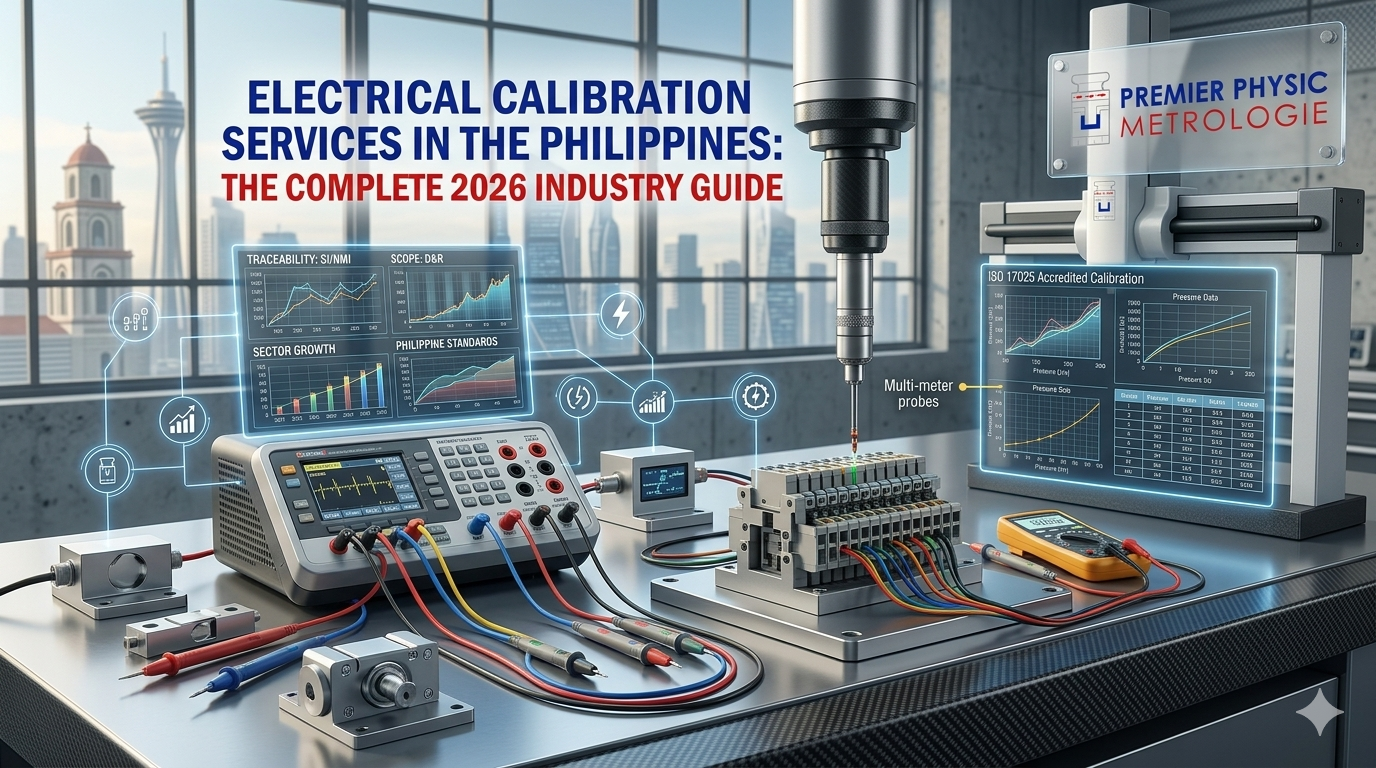
Every Philippine business that tests, monitors, or controls electrical parameters relies on the accuracy of its electrical measuring instruments. The quality engineer who uses a digital multimeter to verify component tolerances at an electronics assembly plant in Laguna. The maintenance technician who uses a clamp meter to check motor current at a food processing facility in Bulacan. The power quality analyst who uses a power analyzer to diagnose energy efficiency at a manufacturing plant in Cavite. The semiconductor process engineer who uses an LCR meter to characterize electronic components at a PEZA ecozone in Batangas.
All of these professionals — and thousands more across Philippine industry — depend on instruments that measure voltage, current, resistance, capacitance, inductance, power, frequency, and other electrical quantities. And all of those instruments are only as trustworthy as their last calibration.
This guide is the most comprehensive resource on electrical calibration services in the Philippines for 2026. It covers what electrical calibration is, which instruments require it, which Philippine industries depend on it most, the regulatory frameworks that require it, how electrical calibration is performed, how to read an electrical calibration certificate, and why Premier Physic Metrologie (PPM Calibration) is the accredited electrical calibration provider Philippine businesses trust.
Section 1: What Is Electrical Calibration?
The Technical Definition
Electrical calibration is the process of comparing the output of an electrical measuring instrument against a known, traceable reference standard under controlled conditions, documenting the difference between the instrument’s reading and the true value, and — where required — adjusting the instrument to bring its readings within acceptable tolerance.
The reference standards used in electrical calibration must be traceable to the SI units of electrical measurement — the volt (V), ampere (A), ohm (Ω), farad (F), henry (H), watt (W), and hertz (Hz) — through an unbroken chain of comparisons ultimately linked to national and international metrology laboratories. In the Philippines, this traceability runs through the Industrial Technology Development Institute (ITDI-DOST), which maintains the Philippine national electrical measurement standards.
Why Electrical Measurement Accuracy Matters
The consequences of inaccurate electrical measurement in Philippine industry range from product quality failures to workplace safety incidents:
- In electronics manufacturing: a multimeter reading 5% high on resistance may cause components to be accepted that are actually out of specification, leading to product failures in the field and costly warranty claims.
- In power systems maintenance: a clamp meter that under-reads current may fail to detect an overloaded circuit — a fire hazard in any Philippine facility.
- In energy management: a power analyzer with incorrect power factor readings provides inaccurate data for energy efficiency assessments — leading to misguided investment decisions and missed energy cost savings.
- In semiconductor fabrication: LCR meters with inaccurate capacitance readings can accept components outside specification, affecting yield and product reliability.
- In quality testing: an uncalibrated insulation resistance tester may pass cables or motors with dangerously low insulation resistance — creating an electrocution risk for maintenance workers and equipment damage risk for operators.
Electrical Calibration vs. Electrical Testing
Electrical calibration and electrical testing are related but distinct activities that are sometimes confused. Electrical calibration verifies the accuracy of a measuring instrument — confirming that the instrument correctly measures the electrical quantity it is designed to measure. Electrical testing uses calibrated instruments to assess the electrical properties of equipment, cables, circuits, or systems — for example, testing insulation resistance of a motor winding.
The key dependency is this: electrical testing is only as valid as the calibration of the instruments used to perform it. An insulation resistance test performed with an uncalibrated megohmmeter produces results of questionable validity. A power quality study conducted with an uncalibrated power analyzer cannot be relied upon for engineering decisions. Electrical calibration is the foundation that makes all electrical testing meaningful.
| Key Principle: In the Philippines, ISO 9001, IATF 16949, and other quality management standards require that all electrical measuring instruments used in quality-critical measurements be calibrated with traceable, ISO/IEC 17025 accredited certificates. Uncalibrated electrical instruments produce measurements of unknown accuracy — which is no measurement at all for compliance purposes. |
Section 2: Electrical Instruments That Require Calibration in the Philippines
Electrical calibration applies to a wide range of instruments across multiple measurement disciplines. Here is a comprehensive overview of the electrical instrument types that PPM Calibration regularly calibrates and their applications in Philippine industry.
Digital Multimeters (DMMs)
The digital multimeter is the most widely used electrical measuring instrument in Philippine industry and one of the most frequently calibrated. A modern DMM measures DC voltage, AC voltage, DC current, AC current, resistance, continuity, and — in more capable models — capacitance, frequency, temperature, and diode characteristics.
DMMs are used by electricians, maintenance technicians, quality engineers, and process operators throughout Philippine manufacturing, utilities, and service industries. Despite their ubiquity and apparent simplicity, DMMs drift over time — their voltage references, analog-to-digital converters, and precision resistor networks change gradually with temperature cycling, humidity exposure, and aging. Annual calibration is the standard interval for DMMs used in quality-critical measurements.
Calibration of a DMM covers all active measurement functions — DC and AC voltage at multiple ranges, DC and AC current at multiple ranges, resistance at multiple ranges, and any additional functions the instrument offers. Reference standards used include precision DC voltage references, current sources, and resistance standards that are themselves traceable to ITDI-DOST and national electrical standards.
Clamp Meters
Clamp meters measure AC current (and in some models DC current) without requiring circuit interruption — by clamping around a conductor and measuring the magnetic field generated by the current flowing through it. They are essential tools for electrical maintenance in Philippine manufacturing plants, buildings, utilities, and infrastructure.
Clamp meter calibration verifies that the instrument correctly measures current across its measurement ranges. Because clamp meters are frequently used to assess whether electrical systems are operating within safe current limits — a critical safety application — their calibration accuracy has direct implications for electrical safety management. An out-of-calibration clamp meter that under-reads current may fail to identify an overloaded circuit that poses a fire or equipment damage risk.
Power Analyzers and Power Quality Analyzers
Power analyzers measure electrical power parameters — active power (watts), reactive power (VAR), apparent power (VA), power factor, and harmonic content — in single-phase and three-phase electrical systems. Power quality analyzers additionally characterize voltage and current harmonics, voltage sags and swells, transients, and frequency deviations.
In the Philippines, power analyzers are used by energy engineers conducting power quality studies and energy audits, by utility metering technicians verifying billing accuracy, by quality engineers testing power supplies and electrical equipment, and by process engineers monitoring the electrical performance of motors and drives.
Power analyzer calibration verifies accuracy across the full range of power measurement parameters — voltage amplitude, current amplitude, phase angle (which determines power factor accuracy), and frequency — at multiple test points. This is a technically complex calibration requiring sophisticated reference equipment and deep metrological expertise.
LCR Meters
LCR meters measure inductance (L), capacitance (C), and resistance (R) of electronic components and circuits. They are essential instruments in Philippine electronics manufacturing for incoming component inspection, production process control, and quality assurance of passive electronic components — resistors, capacitors, inductors, and transformers.
LCR meter calibration verifies accuracy across the instrument’s measurement ranges for each parameter (L, C, R) and at the test frequencies the instrument supports — typically ranging from 100 Hz to 100 kHz or higher for precision LCR meters. Reference standards include precision reference capacitors, inductors, and resistors with certified values traceable to national standards.
Insulation Resistance Testers (Megohmmeters)
Insulation resistance testers — commonly called megohmmeters or meggers — measure the resistance of electrical insulation in cables, motors, transformers, switchgear, and other electrical equipment. They do so by applying a high DC test voltage (typically 500V, 1000V, or 2500V) and measuring the resulting leakage current, from which insulation resistance is calculated.
In the Philippines, insulation resistance testing is a fundamental electrical maintenance practice — used to verify the condition of motor windings before and after overhaul, to assess cable insulation integrity before energization, and to meet preventive maintenance requirements in ISO 9001 and IATF 16949 certified facilities. An out-of-calibration megohmmeter can accept equipment with dangerously degraded insulation — an electrocution and fire risk.
Oscilloscopes
Oscilloscopes display voltage waveforms as a function of time and are used in electronics development, production testing, and troubleshooting applications throughout Philippine electronics manufacturing and engineering. They measure voltage amplitude, frequency, rise time, and waveform shape with high time resolution.
Oscilloscope calibration verifies the accuracy of the vertical (voltage) scale, the horizontal (time) scale, and the trigger sensitivity. Modern digital oscilloscopes have many measurement parameters and functions — calibration typically covers the most critical of these, focusing on the measurement accuracy specifications that define the instrument’s usefulness for its intended application.
Frequency Meters and Counters
Frequency meters and universal frequency counters measure the frequency of electrical signals with high accuracy. They are used in calibration laboratories as frequency references, in telecommunications equipment maintenance, and in production testing of frequency-sensitive components and equipment.
Frequency counter calibration verifies accuracy against a reference frequency standard — typically a traceable frequency reference disciplined to GPS or atomic time standards. Because frequency measurement accuracy depends primarily on the stability of the instrument’s internal oscillator, calibration verifies whether the oscillator has drifted and provides correction data.
Current and Voltage Calibrators
Precision current and voltage calibrators generate highly accurate electrical signals used as references for calibrating other instruments. They are used both in calibration laboratories (where they serve as the reference standard for DMM and meter calibration) and in industrial applications (where they simulate the 4-20 mA signals used by process instruments).
Calibrator calibration — the process of calibrating an instrument that is itself used for calibration — is a critical link in the measurement traceability chain. A calibrator that generates inaccurate signals will cause all instruments calibrated against it to carry the calibrator’s error. PPM Calibration’s electrical reference standards include precision voltage and current calibrators that are regularly calibrated against ITDI-DOST reference standards.
Earth Ground Testers and Loop Impedance Testers
Earth ground testers measure the resistance of electrical grounding systems — a critical safety parameter in all Philippine commercial and industrial facilities. Loop impedance testers measure the impedance of the fault current path in electrical systems, which determines whether overcurrent protective devices will operate correctly under fault conditions.
Both instruments are used by electrical engineers and electrical contractors throughout the Philippines for safety compliance verification and are subject to calibration requirements under electrical safety standards.
Section 3: Philippine Industries That Depend on Electrical Calibration
Electronics and Semiconductor Manufacturing — PEZA Ecozones
The Philippines is one of Southeast Asia’s leading electronics and semiconductor exporters, with major production facilities concentrated in PEZA economic zones in Laguna, Cavite, Batangas, Rizal, and Metro Manila. These facilities produce semiconductors, printed circuit board assemblies, electronic modules, and finished electronic products for global markets — and their quality systems depend heavily on accurate electrical measurement.
Electrical calibration in Philippine electronics manufacturing covers incoming component inspection (LCR meters for passive component characterization), production process control (voltage and current measurement during assembly and testing), product functional testing (DMMs, oscilloscopes, frequency meters), and equipment maintenance (insulation resistance testing of production machinery).
International customers of Philippine electronics manufacturers — in Japan, South Korea, the United States, and Europe — typically require ISO/IEC 17025 accredited calibration certificates as a supplier qualification condition. Through PAB-DAP accreditation and ILAC mutual recognition, PPM Calibration’s certificates are accepted by these international customers without additional verification.
Semiconductor Fabrication — Precision Electrical Measurement
Semiconductor wafer fabrication facilities in the Philippines require the highest levels of electrical measurement accuracy for process control, equipment characterization, and product testing. Precision LCR meters, parameter analyzers, and specialized test equipment used in semiconductor fabrication are calibrated to specifications that often exceed the requirements of general industrial instrumentation.
The calibration of semiconductor fabrication electrical instruments requires specialized expertise and reference equipment. PPM Calibration’s electrical calibration capabilities are suited to the precision requirements of Philippine semiconductor facilities, providing accredited calibration across the measurement ranges and parameter types encountered in fabrication and test environments.
Power Generation and Utilities
Philippine power generation facilities — thermal, hydro, geothermal, solar, and wind — and distribution utilities depend on accurate electrical measurement for energy metering, power quality monitoring, transformer testing, and protective relay calibration. The accuracy of revenue metering in particular has direct commercial significance — billing errors resulting from meter inaccuracy can result in significant financial losses or overcharges.
Electrical calibration in the utilities sector covers revenue meters, power quality analyzers, protection relay test equipment, transformer ratio bridges, and specialized high-voltage measurement equipment. PPM Calibration’s electrical calibration scope serves the measurement disciplines encountered in Philippine utility and power generation applications.
Manufacturing — ISO 9001 and IATF 16949
Philippine manufacturers certified to ISO 9001:2015 and IATF 16949 are required by Clause 7.1.5 to calibrate all measuring equipment used to provide evidence of conformity. In manufacturing, electrical measuring instruments are used extensively in equipment maintenance (DMMs and clamp meters for checking motor electrical parameters), production process control (current and voltage measurement in heating and processing systems), and product quality testing (electrical functional testing of manufactured goods).
IATF 16949 certified automotive component manufacturers face the additional requirement that all electrical test equipment used in product acceptance testing be calibrated with ISO/IEC 17025 accredited certificates — and that measurement system analysis (MSA) be conducted for electrical measurement systems used in critical product characteristic measurements.
Telecommunications
Philippine telecommunications infrastructure — including cell towers, fiber optic networks, data centers, and broadcast facilities — depends on accurate electrical measurement for equipment commissioning, maintenance, and troubleshooting. Signal generators, network analyzers, spectrum analyzers, and power meters used in telecommunications work require regular calibration to maintain measurement validity.
Healthcare — Medical Electrical Equipment
Philippine hospitals and medical device manufacturers use specialized electrical measuring instruments for testing and maintaining medical electrical equipment. Electrical safety analyzers test the leakage current of medical devices — a critical patient safety parameter. Defibrillator analyzers and other medical test equipment require calibration to ensure that safety testing results are valid.
The FDA Philippines regulates medical device manufacturers and requires calibration of all test and measurement equipment used in medical device production and testing. Electrical safety analyzers, output power meters, and other medical test equipment used by Philippine healthcare facilities and medical device manufacturers require regular ISO/IEC 17025 accredited calibration.
Section 4: Regulatory Requirements for Electrical Calibration in the Philippines
| Regulation / Standard | Who It Applies To | Electrical Calibration Requirement |
| ISO 9001:2015 Clause 7.1.5 | All ISO 9001 certified organizations | All electrical measuring instruments used in quality-critical measurements must be calibrated at specified intervals with traceable standards. |
| IATF 16949 | Automotive component manufacturers | All electrical test equipment calibrated with ISO/IEC 17025 certs. MSA required for critical measurement systems. |
| FDA Philippines GMP | Pharmaceutical and medical device manufacturers | All electrical measuring instruments used in manufacturing and QC must be calibrated. Includes instruments used in product testing. |
| Philippine Electrical Code (PEC) | Electrical contractors and facility operators | Test equipment used in electrical compliance testing should be calibrated to ensure valid results. |
| ISO/IEC 17025 (lab accreditation) | Testing and calibration laboratories | All electrical reference standards must be calibrated with full traceability. Measurement uncertainty required. |
| ISO 50001 (Energy Management) | Energy management certified organizations | Energy measurement instruments — power analyzers, electricity meters — must be calibrated for valid energy performance data. |
| IEC 60601 (Medical Electrical Equipment) | Medical device manufacturers and hospitals | Electrical safety analyzers and test equipment used in medical device testing must be calibrated. |
| DOLE OSHS / RA 11058 | All Philippine employers | Electrical instruments used in workplace safety assessment — including electrical hazard testing — must be calibrated. |
Section 5: How Electrical Calibration Is Performed — Methods and Reference Standards
DC Voltage and Current Calibration
DC voltage calibration uses precision DC voltage references — Josephson junction voltage standards at the highest accuracy level, and precision Zener-based voltage references at working standard level — to generate known voltage values against which the instrument under test is compared. The instrument’s reading at each test voltage is recorded and the deviation from the true value is documented.
DC current calibration uses precision current sources and shunt resistors to generate known current values. The instrument’s current reading is compared against the true current at multiple test points across its measurement range.
AC Voltage and Current Calibration
AC voltage and current calibration is more complex than DC calibration because it involves both amplitude accuracy and frequency dependence. The reference standards used for AC electrical calibration include precision AC voltage sources, AC current sources, and thermal transfer standards that convert AC quantities to equivalent DC quantities for comparison.
AC electrical calibration covers the amplitude accuracy of the instrument at multiple voltage or current values, and — for instruments that operate across multiple frequencies — the frequency response of the instrument’s AC measurement at different frequencies (typically 50 Hz, 60 Hz, 1 kHz, and higher).
Resistance Calibration
Resistance calibration uses precision reference resistors — resistors with highly stable, traceable resistance values — as the reference against which the instrument’s resistance readings are compared. Reference resistance standards range from sub-ohm values (for testing low-resistance measurement functions) to high-resistance values in the gigaohm range (for testing high-resistance and insulation resistance measurement functions).
Frequency Calibration
Frequency calibration uses a traceable frequency reference — typically a GPS-disciplined oscillator or rubidium atomic frequency standard — to generate known frequencies against which frequency meters and counters are calibrated. Because modern GPS-disciplined frequency references are extremely stable and accurate, frequency calibration can achieve very low measurement uncertainties.
Power and Energy Calibration
Power calibration is among the most complex electrical calibration disciplines because it requires simultaneous accuracy in voltage, current, and phase angle — the three quantities that determine electrical power. Reference power standards use precision phase angle generators and precision voltage and current sources to create known power values for calibration comparison.
Power factor accuracy — the accuracy of the phase angle measurement — is often the dominant source of error in power analyzer calibration and requires careful attention during calibration.
Electrical Calibration Reference Equipment at PPM Calibration
| Reference Equipment | What It Calibrates |
| Precision DC voltage/current reference (Fluke 5522A class) | DMMs — DC voltage and DC current ranges |
| Precision AC voltage/current source | DMMs and clamp meters — AC voltage and AC current ranges |
| Decade resistance boxes and standard resistors | DMMs — resistance ranges; LCR meters — resistance parameter |
| Precision capacitance standards | LCR meters — capacitance parameter across frequency range |
| Precision inductance standards | LCR meters — inductance parameter across frequency range |
| GPS-disciplined frequency reference | Frequency meters, counters, oscilloscope time base |
| Precision power reference standard | Power analyzers — active power, reactive power, power factor |
| High-resistance standard (1 GΩ+) | Insulation resistance testers — high-resistance ranges |
| Precision oscilloscope reference | Oscilloscopes — vertical scale and time base calibration |
Section 6: Reading an Electrical Calibration Certificate — What Matters
An ISO/IEC 17025 compliant electrical calibration certificate contains specific technical information that your quality auditors and regulatory inspectors will review. Understanding what each element means helps you use the certificate correctly and identify non-compliant certificates.
Essential Elements of a Compliant Electrical Calibration Certificate
- Instrument identification: Make, model, serial number, and asset tag of the electrical measuring instrument calibrated.
- Calibration date: The date calibration was performed — determines next calibration due date.
- Functions calibrated: Explicit list of which measurement functions were included — DC voltage ranges, AC voltage ranges, resistance ranges, etc. Important because not all functions may be calibrated in every service.
- Calibration method: Reference to the documented procedure used for each measurement function.
- Reference standards: Identification of the reference equipment used, with traceability certificate numbers.
- Test points and results: The specific values applied and the instrument’s readings at each test point — for every function calibrated.
- As-found readings: Instrument readings before any adjustment — showing actual performance before intervention.
- As-left readings: Instrument readings after any adjustment — showing performance at certificate issue.
- Measurement uncertainty: Expressed as ±X (in the relevant unit — mV, mA, mΩ, etc.) with coverage factor for each test point. Non-negotiable for ISO/IEC 17025 compliance.
- Traceability statement: Links results through reference standards to ITDI-DOST and BIPM.
- Authorized metrologist signature: Confirms technical review and approval.
Why Function Coverage Matters in Electrical Calibration Certificates
Unlike temperature calibration — where an instrument typically has one measurement function — a digital multimeter may have 10 or more measurement functions (DC voltage at multiple ranges, AC voltage at multiple ranges, DC current, AC current, resistance at multiple ranges, frequency, capacitance, diode test, etc.). A calibration certificate may not cover all of these functions.
This is an important practical point: when you review an electrical calibration certificate, check which functions are actually covered. If your quality process uses the DMM’s resistance function and the calibration certificate covers only voltage and current functions, the resistance measurement is not certified — you have a gap in your calibration coverage.
PPM Calibration’s electrical calibration service covers all active measurement functions on each instrument calibrated, within the instrument manufacturer’s specification. Ensure you specify all functions relevant to your quality process when requesting calibration.
| Quality Manager Tip: When reviewing electrical calibration certificates during an ISO audit preparation, check three things for each DMM in your inventory: (1) Are all functions used in quality-critical measurements included in the certificate? (2) Does the certificate include measurement uncertainty at each test point? (3) Is the calibration current — not expired? If any of these are missing, the certificate may not satisfy your auditor. |
Section 7: Electrical Calibration Intervals — Setting the Right Schedule
Factors That Determine Electrical Calibration Interval
The appropriate calibration interval for electrical measuring instruments depends on several factors that vary by instrument type and application:
- Instrument stability and drift rate: High-precision DMMs and calibrators typically have better long-term stability than general-purpose instruments, and their intervals can often be extended based on historical drift data.
- Frequency and severity of use: An instrument used continuously in a harsh factory environment will drift more quickly than one used occasionally in a controlled laboratory.
- Criticality of measurements: Instruments used in product release decisions, safety-critical measurements, or revenue metering should be calibrated more frequently than those used for general monitoring.
- Regulatory requirements: ISO 9001, IATF 16949, and industry-specific standards may specify minimum calibration intervals for electrical instruments in specific applications.
- Manufacturer recommendations: Most instrument manufacturers specify a recommended calibration interval in the instrument manual — typically 12 months for precision instruments.
Recommended Electrical Calibration Intervals in Philippine Industry
| Instrument Type | Recommended Interval | Key Consideration |
| Precision DMMs (6.5 digit and above) | 12 months | High-value reference instruments — drift data may allow extension |
| General-purpose DMMs (4.5 digit) | 12 months | Standard interval — shorten for harsh environments |
| Clamp meters | 12 months | Safety-critical current measurement — never extend without drift data |
| Power analyzers | 12 months | Complex calibration — all power parameters must be covered |
| LCR meters | 12 months | Critical for component incoming inspection in electronics |
| Insulation resistance testers | 12 months | Safety-critical — short interval for safety-compliance applications |
| Oscilloscopes | 12 months | All vertical scales and time base ranges should be covered |
| Frequency meters/counters | 12–24 months | Very stable GPS-referenced instruments may extend to 24 months |
| Current and voltage calibrators | 12 months | Used as working standards — high priority for regular calibration |
| Earth ground testers | 12 months | Safety application — maintain short interval |
| Revenue electricity meters | Regulatory schedule | Philippine ERC and utility regulations specify metering calibration intervals |
Section 8: PPM Calibration — The Philippines’ Trusted Electrical Calibration Provider
25 Years of Electrical Calibration Experience in the Philippines
Premier Physic Metrologie has been delivering ISO/IEC 17025 accredited electrical calibration services in the Philippines for 25 years. In that time, PPM’s electrical calibration team has served electronics manufacturers in PEZA ecozones, semiconductor facilities in Laguna and Cavite, manufacturing plants throughout Luzon, utilities and power facilities, hospitals and medical device companies, and calibration laboratories that use PPM-calibrated reference equipment as the basis for their own measurement programs.
This 25-year track record in Philippine electrical calibration represents an institutional depth of experience that is difficult to replicate. PPM’s electrical calibration metrologists have encountered virtually every instrument type, every calibration challenge, and every compliance requirement that Philippine industry presents — and have built the procedures, the reference equipment, and the quality system to address all of them to ISO/IEC 17025:2017 standard.
ISO/IEC 17025:2017 PAB-DAP Accredited Electrical Calibration
PPM Calibration’s electrical calibration services are performed under its current ISO/IEC 17025:2017 accreditation from the Philippine Accreditation Bureau (PAB-DAP). Every electrical calibration certificate PPM issues is:
- Traceable to ITDI-DOST and through ITDI to the BIPM international electrical measurement standards
- Accompanied by measurement uncertainty values at every test point, calculated per GUM methodology
- Covering all specified measurement functions of each instrument calibrated
- Accepted by ISO 9001, IATF 16949, and FDA Philippines auditors and inspectors
- Internationally recognized through APLAC and ILAC MRA signatory status
Electrical Calibration Scope at PPM Calibration
PPM Calibration’s electrical calibration scope covers the major electrical measurement disciplines required by Philippine electronics, semiconductor, manufacturing, utilities, and industrial sectors:
| Electrical Parameter | Instruments Covered |
| DC Voltage | DMMs, voltage calibrators, DC power supplies, dataloggers |
| AC Voltage | DMMs, power analyzers, true-RMS meters, voltage references |
| DC Current | DMMs, current calibrators, panel meters, dataloggers |
| AC Current | DMMs, clamp meters, power analyzers, current transformers |
| Resistance | DMMs, resistance bridges, LCR meters (R parameter), decade boxes |
| Capacitance | LCR meters (C parameter), capacitance bridges |
| Inductance | LCR meters (L parameter), inductance bridges |
| Frequency | Frequency meters, counters, oscilloscope time base |
| Power / Power Factor | Power analyzers, power quality analyzers, wattmeters |
| Insulation Resistance | Megohmmeters, insulation testers (500V to 5kV) |
| Oscilloscope parameters | Vertical scale, time base, bandwidth verification |
Laboratory and Onsite Electrical Calibration
PPM Calibration provides electrical calibration in both service modes, allowing clients to choose the approach that best suits their operational needs:
Laboratory electrical calibration: Portable electrical instruments — DMMs, clamp meters, LCR meters, oscilloscopes, insulation testers — are delivered to PPM’s laboratory where they are calibrated using precision electrical reference equipment in a controlled environment. This service mode provides the lowest measurement uncertainty and is recommended for precision reference instruments and calibrators.
Onsite electrical calibration: PPM’s mobile calibration team visits client facilities with portable electrical calibration equipment — including precision multi-function calibrators capable of generating accurate voltage, current, resistance, and frequency values — and calibrates installed panel meters, process control instruments, and electrical test equipment in place. Onsite electrical calibration is particularly valuable for facilities with large numbers of panel meters, process instruments, and installed test equipment that would be impractical to remove for laboratory calibration.
Section 9: Frequently Asked Questions — Electrical Calibration in the Philippines
Q: What is electrical calibration and why is it required in the Philippines?
A: Electrical calibration is the process of verifying and documenting the accuracy of electrical measuring instruments — such as multimeters, clamp meters, power analyzers, and LCR meters — against traceable reference standards. It is required in the Philippines because ISO 9001 Clause 7.1.5, IATF 16949, FDA Philippines GMP, and other regulatory frameworks mandate that all measuring instruments used in quality-critical applications be calibrated at defined intervals with documented traceability. Beyond compliance, electrical calibration ensures that measurements used in production decisions, safety assessments, and energy management are scientifically valid.
Q: How often should multimeters and clamp meters be calibrated in the Philippines?
A: The standard calibration interval for digital multimeters and clamp meters in Philippine industrial and manufacturing applications is 12 months. This applies to both general-purpose and precision instruments. Instruments used in safety-critical measurements — such as clamp meters used to verify circuit current for electrical safety compliance — should not have their intervals extended without solid historical drift data supporting the extension. PPM Calibration can review your instrument’s calibration history and advise on appropriate interval adjustment.
Q: Does electrical calibration cover all functions on a multimeter?
A: It depends on the scope of calibration specified and performed. A comprehensive electrical calibration should cover all active measurement functions on the instrument — DC voltage at all ranges, AC voltage at all ranges, DC current at all ranges, AC current at all ranges, resistance at all ranges, and any additional functions (frequency, capacitance, temperature) relevant to the instrument’s use. PPM Calibration’s electrical calibration service covers all specified functions, within the manufacturer’s published specifications. When requesting calibration, specify all functions your quality process relies on.
Q: Can PPM Calibration calibrate our LCR meters for incoming component inspection in our electronics factory?
A: Yes. PPM Calibration provides ISO/IEC 17025 accredited LCR meter calibration covering inductance, capacitance, and resistance parameters across the frequency ranges used in electronic component characterization. PPM’s electrical calibration reference equipment includes precision capacitance and inductance standards traceable to national electrical measurement standards. LCR meter calibration at PPM is accepted by the ISO 9001 and IATF 16949 auditors of Philippine electronics and automotive component manufacturers.
Q: Is electrical calibration from PPM accepted by international customers of Philippine electronics manufacturers?
A: Yes. PPM Calibration holds ISO/IEC 17025:2017 PAB-DAP accreditation, and PAB-DAP is a signatory member of APLAC and ILAC. This means PPM’s electrical calibration certificates carry ILAC MRA recognition — accepted by customers, auditors, and regulators in all ILAC member countries including Japan, South Korea, the United States, Germany, Singapore, and Taiwan. Philippine electronics manufacturers can use PPM certificates to satisfy international supplier calibration requirements without additional verification.
Q: Can PPM Calibration perform electrical calibration at our PEZA ecozone facility?
A: Yes. PPM Calibration regularly provides both laboratory and onsite electrical calibration services to clients in PEZA economic zones throughout Laguna, Cavite, Batangas, Rizal, and other ecozone locations accessible from Metro Manila. Laboratory calibration is available for all portable electrical instruments. Onsite calibration is available for installed panel meters, process instruments, and large electrical test equipment that cannot be practically transported. Contact PPM Calibration to discuss logistics and scheduling for your specific ecozone location.
Q: What is measurement uncertainty in electrical calibration and why does it matter?
A: Measurement uncertainty in electrical calibration quantifies how much the true electrical value might differ from the value measured by the reference standard — it represents the combined effect of all sources of error in the calibration process. For example, a certificate might state that at 10.000V DC, the reference uncertainty is ±0.002V (k=2). This means the true voltage is expected to be between 9.998V and 10.002V with 95% confidence. This information is essential for determining whether the instrument’s calibration error — combined with the reference uncertainty — is acceptable for its intended application. Certificates without uncertainty values are not ISO/IEC 17025 compliant.
Q: How do I request electrical calibration services from PPM Calibration?
A: Visit ppmcalibration.com/request-a-quote and provide your instrument list — including make, model, serial number, the measurement functions you need calibrated, and your facility location. PPM Calibration will confirm scope coverage, provide a quotation, and schedule your calibration. For electronics and semiconductor facilities with large instrument inventories, PPM can also arrange a site survey to assess onsite calibration requirements and plan a comprehensive campaign. All initial consultations are free of charge.
Conclusion: Electrical Calibration Is the Foundation of Reliable Measurement in Philippine Industry
In the Philippines’ growing electronics, semiconductor, manufacturing, and utilities sectors, the accuracy of electrical measurement underpins product quality, process control, energy efficiency, and worker safety. Every multimeter, every clamp meter, every power analyzer, every LCR meter that produces measurement data your team relies on is only as trustworthy as its last calibration.
Electrical calibration from an ISO/IEC 17025 accredited laboratory gives you something unaccredited calibration cannot: independent, expert-verified assurance that your electrical instruments are producing valid measurements, documented with the traceability and uncertainty data your ISO auditors, IATF assessors, FDA inspectors, and international customers require.
Premier Physic Metrologie (PPM Calibration) has spent 25 years building the electrical calibration capability, the accredited quality system, and the client relationships that make it the Philippines’ most trusted electrical calibration provider. From DMMs and clamp meters to power analyzers and LCR meters, from electronics factories in Laguna to semiconductor facilities in Cavite, from utility metering stations to hospital equipment rooms — PPM Calibration delivers electrical calibration that Philippine industry can measure by.
| Ready to schedule electrical calibration for your Philippine facility? Visit ppmcalibration.com/electrical-calibration-services or request a free quote at ppmcalibration.com/request-a-quote. PPM Calibration — 25 years of electrical calibration excellence in the Philippines. |
| About the AuthorThis article was produced by Premier Physic Metrologie, Incorporated (PPM Calibration) — an ISO/IEC 17025:2017 accredited calibration laboratory in the Philippines with 25 years of experience serving electronics, semiconductor, manufacturing, utilities, and industrial clients nationwide.Website: ppmcalibration.com | Facebook: @ppmcalab | Instagram: @ppmcalab | LinkedIn: Premier Physic Metrologie |