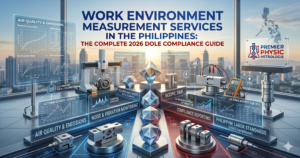

In the bustling industrial zones of Laguna, the high-rise BPOs of Makati, and the massive shipyards of Subic, a quiet revolution is taking place in the way Filipino companies view their physical space. For decades, “safety” in the Philippine workplace was largely synonymous with wearing hard hats and placing “Wet Floor” signs. Today, however, the focus has shifted from visible physical dangers to the invisible hazards that permeate the air, soundscape, and lighting of the work environment.
This shift is driven by Work Environment Measurement (WEM)—the scientific determination and evaluation of physical, chemical, and biological hazards in the workplace. As of 2026, WEM has moved from a “niche technical requirement” to a primary strategic priority for Philippine businesses.
Part 1: The Regulatory Catalyst – RA 11058 and DO 198-18
The most immediate reason for the surge in WEM priority is the rigorous enforcement of Republic Act No. 11058, otherwise known as the “Occupational Safety and Health (OSH) Law.” Signed into law to modernize the 1978 OSH Standards, its Implementing Rules and Regulations (IRR) found in Department Order No. 198-18 (DO 198-18) have introduced teeth into what was previously a toothless set of guidelines.
No More Exemptions: The Universal Mandate
Before RA 11058, many small-to-medium enterprises (SMEs) in the Philippines operated under the assumption that they were too small for DOLE to notice. The new law clarified that all covered workplaces—regardless of the number of employees—must comply with OSH standards.
- Rule 1077 Requirements: Under the OSH Standards, WEM is mandatory for any workplace where workers may be exposed to physical or chemical hazards.
- Periodic Conduct: DOLE mandates that WEM must be conducted at least once a year (or more frequently if there are changes in processes or materials) to ensure that workers are not repeatedly exposed to levels exceeding the Threshold Limit Values (TLVs).
The Penalty Factor
One of the strongest reasons businesses are prioritizing WEM is the risk of non-compliance. RA 11058 introduced administrative fines that can reach up to ₱100,000 per day for willful failure to comply with OSH standards or to correct a violation. For many Filipino companies, the cost of a comprehensive WEM study from an accredited provider is a fraction of the potential fines.
Part 2: Defining the WEM Parameters – Beyond the Thermometer
WEM is not a single test; it is a multi-parameter diagnostic of a building’s “health.” Philippine businesses are now investing in specialized monitoring to capture a holistic view of their environment.
Physical Hazards
These are the most common parameters measured in both office and industrial settings:
- Illumination (Lighting): Measured in Lux, proper lighting is critical for both safety and productivity. WEM identifies “shadow zones” in warehouses that cause accidents and “glare zones” in offices that lead to worker migraines and eye strain.
- Noise Levels: In manufacturing and BPOs (due to headset use), noise is a major concern. WEM uses Sound Level Meters and Noise Dosimeters to ensure levels stay below the 90 dBA threshold for an 8-hour shift.
- Heat Stress and Humidity: Given the Philippine climate, managing “Heat Stress” is vital. WEM evaluates the Wet Bulb Globe Temperature (WBGT) to determine if workers need more frequent rest breaks or better ventilation.
Chemical and Atmospheric Hazards
For the manufacturing, electronics, and chemical sectors, WEM focuses on what workers are breathing:
- Dust and Particulates: Measuring respirable dust (PM10 and PM2.5) to prevent long-term lung diseases like silicosis.
- Organic Solvents and Gases: Detecting the concentration of harmful vapors (e.g., Benzene, Formaldehyde, or Ammonia). WEM compares these concentrations against the TLVs to determine if the existing Local Exhaust Ventilation (LEV) is actually working.
Part 3: The “Productivity Link” – Why HR and Operations Care
While DOLE compliance starts the conversation, the Return on Investment (ROI) is what keeps WEM at the top of the priority list. Filipino CEOs are beginning to realize that a “healthy” environment is a high-performance environment.
Reducing Absenteeism and “Presenteeism”
High levels of carbon dioxide ($CO_2$) in poorly ventilated offices—a common issue in Metro Manila high-rises—lead to drowsiness, poor concentration, and headaches.
- The CO2 Metric: WEM monitors $CO_2$ levels to ensure they stay below 1,000 ppm.
- Result: By improving air quality based on WEM findings, businesses see a measurable drop in employee sick days and a rise in afternoon productivity levels.
Talent Retention in the BPO Sector
In the highly competitive Philippine BPO industry, employee “attrition” is a million-dollar problem. Workers are increasingly choosing employers who can prove, through certified WEM reports, that their offices have optimal acoustics and air quality. Providing a safe work environment has become a “recruitment advantage” in the war for talent.
Summary of Initial WEM Priority Factors
| Factor | Business Impact | Regulatory Reference |
| Legal Compliance | Avoidance of fines up to ₱100k/day. | RA 11058 / DO 198-18 |
| Risk Mitigation | Lowering the insurance and liability costs of occupational illness. | OSHS Rule 1070 |
| Productivity | Boosting focus and reducing fatigue through better lighting/air. | Rule 1075 / 1076 |
| Brand Reputation | Aligning with ESG (Environmental, Social, Governance) goals. | International Standards |
Conclusion
The prioritization of Work Environment Measurement in the Philippines marks the maturity of the local business sector. We are moving away from a culture of “compliance by accident” to “protection by design.” As businesses realize that the data provided by WEM protects both their people and their profits, the demand for these technical services will only continue to grow.