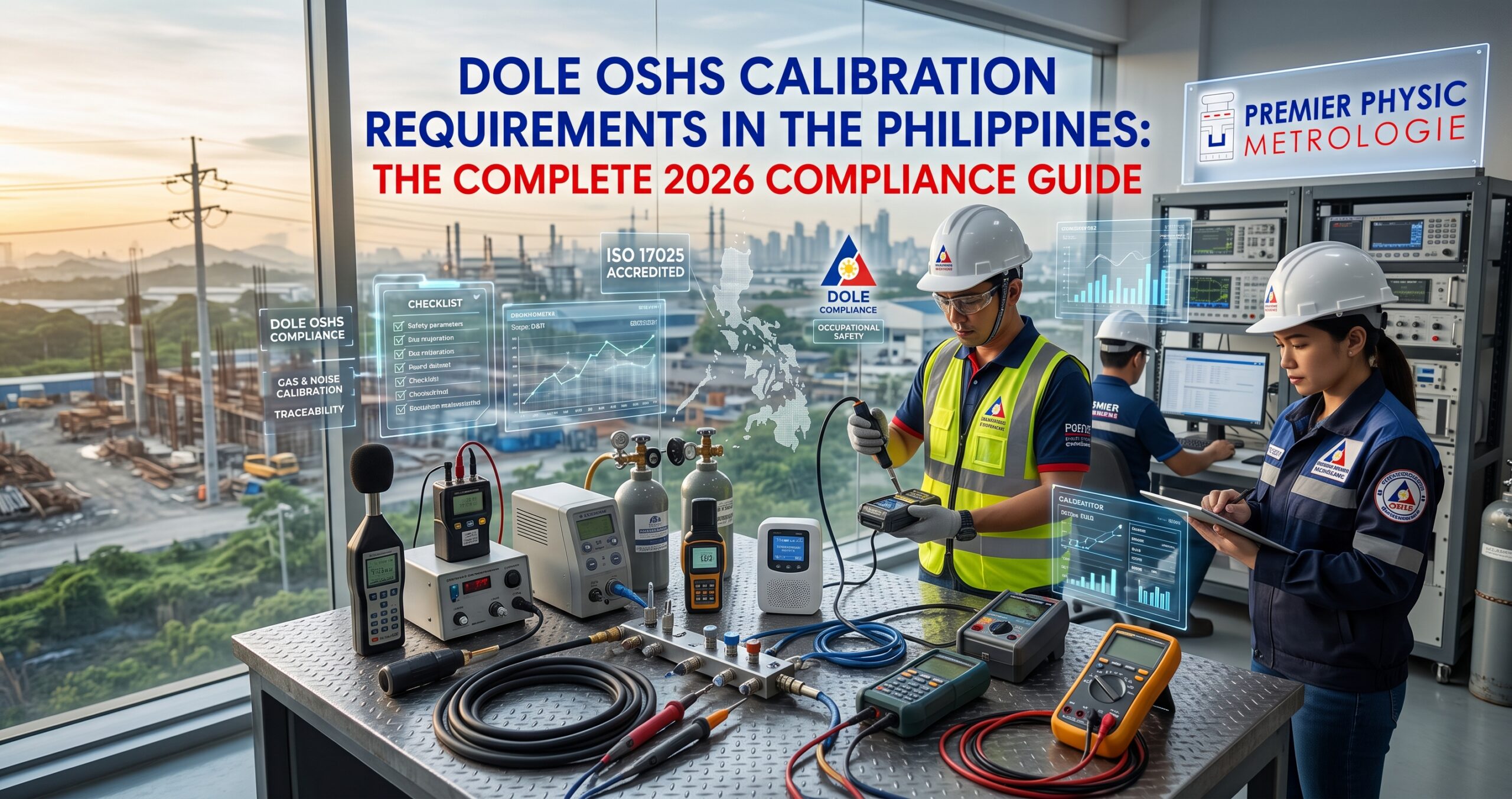
Every employer in the Philippines — from a small manufacturing plant with 10 workers to a major multinational with thousands of employees — is subject to the Occupational Safety and Health Standards enforced by the Department of Labor and Employment. Under Republic Act 11058 (OSH Law of 2018) and its implementing rules, employers have a legal obligation to provide a safe and healthy workplace. And in practice, demonstrating compliance with that obligation requires measuring the physical hazards present in the workplace — noise levels, thermal conditions, chemical exposures, illuminance levels — using calibrated measurement instruments whose results are documented, traceable, and defensible.
DOLE OSHS calibration requirements are unique in the Philippine regulatory landscape because they apply to the broadest cross-section of Philippine industry of any calibration standard. While FDA Philippines calibration requirements apply to pharmaceutical and food manufacturers, and ISO 9001 calibration requirements apply only to certified companies, DOLE OSHS occupational safety measurement requirements apply to virtually every Philippine employer with workers. Every factory, every construction site, every office building, every hospital, every warehouse, every call center that has workers exposed to potential physical health hazards must manage those hazards using calibrated measurement instruments.
This guide is the most comprehensive resource on DOLE OSHS calibration requirements in the Philippines for 2026. It covers the legal framework, the specific instruments that require calibration for OSHS compliance, the Work Environment Measurement (WEM) program that formalizes occupational safety measurement, what DOLE safety officers look for during workplace inspections, the consequences of non-compliance, and how PPM Calibration’s accredited WEM services provide complete DOLE OSHS calibration compliance documentation.
Section 1: The Philippine OSHS Legal Framework — RA 11058 and Its Calibration Implications
Republic Act 11058 — The OSH Law of 2018
Republic Act 11058, signed into law in 2018, significantly strengthened the Philippines’ occupational safety and health regulatory framework — increasing penalties for violations, expanding DOLE enforcement authority, and clarifying employer obligations for workplace safety. The law applies to all employers, workers, and workplaces in the private sector, including those in the informal economy and in industries not previously covered by the older Occupational Health and Safety Standards.
Key RA 11058 provisions affecting calibration compliance:
- Section 5 — General Duties of Employers: Employers must furnish workers with a place of employment free from hazards that are likely to cause death or serious physical harm. To demonstrate that hazard levels are below harmful thresholds, employers must measure those hazard levels using calibrated instruments.
- Section 16 — Safety and Health Programs: Employers with more than 10 workers must establish an occupational safety and health program — which includes workplace hazard monitoring as a required program element. The instruments used for hazard monitoring must be calibrated.
- Section 18 — Administrative Penalties: RA 11058 increased penalties for OSH violations to up to 100,000 pesos per day of violation. Failure to maintain calibrated safety measurement instruments — resulting in invalid occupational exposure data — is a violation that can attract these penalties during DOLE inspection.
DOLE Department Order 198, Series of 2018 — The Implementing Rules
DOLE Department Order 198 (IRR of RA 11058) provides the detailed implementing rules for workplace safety and health in the Philippines. Key provisions relevant to calibration:
- Rule 1090 (Work Environment Measurement): The WEM program requires measurement of physical and chemical hazards in the workplace using appropriate instruments. WEM results must be documented and submitted to DOLE as part of the employer’s OSH compliance reporting.
- Rule 1070 (Threshold Limit Values): Establishes the permissible exposure limits for physical hazards — noise, heat, illuminance, vibration, radiation — that employers must demonstrate their workers are not exceeding. Meeting these limits requires accurate measurement.
- Rule 1030 (Training of Safety Personnel): Safety officers responsible for conducting workplace hazard measurements must be competent — which includes understanding the calibration requirements for the instruments they use.
The Work Environment Measurement (WEM) Program
The Work Environment Measurement program is the DOLE OSHS mechanism for systematic measurement and documentation of physical workplace hazards. Under the WEM program:
- Employers must conduct WEM at defined intervals — at least annually for workplaces where hazard levels are near threshold limit values, and whenever working conditions change significantly
- WEM must be conducted using appropriate, calibrated measurement instruments — instruments whose calibration is traceable to national standards
- WEM reports must document the instruments used, their calibration status, the measurement results, and the comparison against applicable Threshold Limit Values (TLVs)
- WEM reports are submitted to DOLE and retained as compliance records available for DOLE safety officer review during workplace inspections
| PPM Calibration’s WEM Service: PPM Calibration provides complete Work Environment Measurement services for Philippine employers — using ISO/IEC 17025 calibrated instruments to measure noise levels, heat stress, illuminance, and other occupational exposure parameters, and producing WEM reports in the format required by DOLE OSHS. This service combines calibrated instrument use with expert interpretation of results against DOLE threshold limit values, providing employers with complete DOLE OSHS WEM compliance documentation. Contact ppmcalibration.com to schedule a WEM service for your facility. |
Section 2: DOLE OSHS Occupational Safety Instruments Requiring Calibration
Philippine employers conducting Work Environment Measurements must use calibrated instruments for each physical hazard parameter measured. Here is a comprehensive guide to the instruments requiring calibration for DOLE OSHS compliance.
Sound Level Meters — Noise Measurement
Noise is the most widespread physical workplace hazard in Philippine industry — affecting workers in manufacturing facilities, construction sites, airports, call centers, entertainment venues, power plants, and many other workplaces. Excessive noise exposure causes permanent hearing loss — a non-reversible occupational disease that affects hundreds of thousands of Filipino workers.
DOLE OSHS noise requirements under Rule 1078 (Control of Noise Exposure):
- The permissible noise exposure for an 8-hour working day is 90 dBA (decibels, A-weighted)
- For exposure periods shorter than 8 hours, higher noise levels are permissible per the DOLE exposure duration table — e.g., 95 dBA for 4 hours, 100 dBA for 2 hours
- Noise levels must be measured using a Type 1 or Type 2 sound level meter in accordance with IEC 61672
- Workplace noise surveys must be conducted whenever noise levels may exceed 85 dBA, whenever new equipment is installed that may increase noise levels, or whenever process changes may affect noise exposure
Sound level meter calibration requirements for DOLE OSHS compliance:
- Annual calibration: Sound level meters used for DOLE OSHS noise surveys must be calibrated annually by an ISO/IEC 17025 accredited laboratory. PPM Calibration provides IEC 61672-compliant sound level meter calibration with certificates documenting calibration at frequency-weighted A-weighting accuracy, directional response, and level accuracy.
- Acoustic calibrator (pistonphone) verification: Before each noise survey, the sound level meter must be verified using a calibrated acoustic calibrator — a pistonphone or sound level calibrator that generates a reference sound pressure level (typically 94 dB at 1000 Hz). The acoustic calibrator itself must be calibrated annually.
- Noise dosimeter calibration: Personal noise dosimeters — worn by workers to measure individual noise dose over the working shift — require the same annual calibration standard as sound level meters, plus field verification using a calibrated acoustic calibrator before each dosimetry survey.
WBGT Meters — Heat Stress Measurement
The Philippines’ tropical climate makes heat stress one of the most significant occupational health hazards for workers in outdoor construction, agriculture, outdoor industrial work, and indoor facilities without adequate cooling. DOLE OSHS Rule 1074 (Heat Stress) specifies:
- Heat stress is measured using the Wet Bulb Globe Temperature (WBGT) index — a composite index that combines dry bulb temperature, wet bulb temperature (humidity), and globe temperature (radiant heat)
- DOLE OSHS specifies permissible WBGT values for different work intensities (light, moderate, heavy work) and work-rest regimes
- Heat stress monitoring is required for workers in outdoor work and in indoor facilities where WBGT may exceed 28 degrees C
WBGT meter calibration requirements for DOLE OSHS compliance:
- Annual calibration: WBGT meters used for DOLE OSHS heat stress assessments must be calibrated annually. WBGT meter calibration verifies the accuracy of the dry bulb temperature sensor, the wet bulb thermometer assembly, and the black globe temperature sensor — separately and as a combined WBGT index.
- Calibration at relevant temperature ranges: WBGT meters used in Philippine outdoor conditions must be calibrated at temperature ranges relevant to tropical workplace exposures — typically 25 to 45 degrees C for the temperature components of WBGT measurement.
Illuminance Meters (Lux Meters) — Lighting Level Measurement
Workplace illumination levels affect worker safety and performance — insufficient lighting increases accident risk and eye strain; excessive contrast creates visual fatigue and error. DOLE OSHS Rule 1075 (Illumination) specifies minimum illuminance levels for different work activities:
- 20 lux minimum: storage areas, corridors, exits
- 50 lux: rough work areas, loading docks
- 100 lux: medium bench and machine work
- 200 lux: fine bench and machine work
- 300 lux: very fine precision work
- 500 lux or more: extremely fine work, surgical areas
Illuminance meter (lux meter) calibration for DOLE OSHS compliance:
- Annual calibration: Illuminance meters (lux meters) used for DOLE OSHS lighting surveys must be calibrated annually against a traceable reference standard. Calibration verifies the accuracy of the illuminance reading at multiple reference illuminance levels and confirms cosine correction (the meter’s ability to correctly measure light arriving at different angles).
- Spectral response calibration: Professional lux meters are calibrated for photometric measurement — their spectral response matches the CIE photopic luminosity function. Calibration confirms that the meter’s response is correctly weighted for human visual perception.
Gas Detectors and Air Quality Monitors
Chemical hazards in the workplace — flammable gases, toxic gases, oxygen deficiency — require calibrated gas detection instruments for worker protection. DOLE OSHS provisions on chemical hazards and confined space entry specifically require calibrated gas detection instruments:
Confined Space Gas Detection — The Most Critical OSHS Calibration Requirement
Confined space entry is one of the most dangerous activities in Philippine workplaces — with oxygen deficiency, flammable gas, and toxic gas being the primary confined space fatality causes. DOLE OSHS confined space entry procedures require:
- Multi-gas detector annual calibration: All multi-gas detectors used for confined space atmospheric testing must be formally calibrated at least annually by a competent person using certified reference gas mixtures. Annual calibration verifies the accuracy of all sensor channels — LEL, oxygen, H2S, CO — at known reference concentrations.
- Bump test before every confined space entry: Before each confined space entry, the multi-gas detector must be bump-tested — briefly exposing each sensor to a certified reference gas to confirm it responds and alarms. The bump test is not a calibration — it confirms sensor response but not quantitative accuracy. Both annual calibration AND pre-entry bump testing are required under DOLE OSHS.
- Certified reference gas: Calibration and bump testing must use certified reference gas mixtures with traceable concentration values — not air or ambient gas. Reference gas cylinders must have valid certification from an accredited gas calibration laboratory.
| DOLE OSHS Confined Space Fatality Prevention: Confined space fatalities in Philippine workplaces are consistently reported — and most involve failure of atmospheric testing procedures. An uncalibrated gas detector that gives false readings of safe oxygen levels or safe gas concentrations can directly cause worker deaths when workers enter a space that appears safe but is actually oxygen-deficient or gas-contaminated. Calibrated, bump-tested gas detectors are the difference between a safe confined space entry and a fatal accident. DOLE OSHS requires both. PPM Calibration provides the annual calibration component. |
Fixed Gas Detection Systems
Fixed gas detectors permanently installed in Philippine manufacturing, petroleum, chemical, and power generation facilities to provide continuous area monitoring require the same calibration standards as portable units:
- Annual formal calibration using certified reference gas — verifying sensor accuracy and alarm setpoint response at known gas concentrations
- Regular in-situ challenge tests — periodic injection of reference gas at the detector head to confirm sensor response without removing the detector from service
- Calibration records documenting each annual calibration and in-situ challenge test — available for DOLE safety officer review during workplace inspections
Ambient Air Quality Monitors — Chemical Exposure Monitoring
For workplaces with chemical exposure hazards — paints, solvents, adhesives, cleaning chemicals, industrial gases — ambient air quality monitoring verifies that worker chemical exposures remain below DOLE OSHS permissible exposure limits (PELs). The instruments used for ambient chemical monitoring include:
- Photoionization detectors (PIDs): For measuring volatile organic compound (VOC) concentrations in workplaces using organic solvents — painting operations, chemical manufacturing, printing. PID calibration uses certified reference gas (typically isobutylene) at a known concentration.
- Electrochemical toxic gas monitors: For measuring specific toxic gas concentrations — carbon monoxide, hydrogen sulfide, nitrogen dioxide, sulfur dioxide — in industrial workplaces. Annual calibration using certified reference gas at concentrations relevant to workplace exposure limits.
- Dust sampling instruments: Gravimetric dust sampling using personal sampling pumps and filter holders measures respirable or inhalable dust exposure for workers in dusty environments — construction, mining, woodworking, grain handling. Personal sampling pump calibration verifies the flow rate accuracy at the specified sampling flow rates.
Vibration Measurement Instruments
Occupational vibration exposure — both hand-arm vibration (HAV) from power tools and whole-body vibration (WBV) from vehicles and machinery — is an occupational health hazard addressed under DOLE OSHS and international standards. While Philippine OSHS standards for occupational vibration are less explicitly specified than for noise and heat, the international standards referenced by Filipino OSH professionals (ISO 5349 for hand-arm vibration, ISO 2631 for whole-body vibration) require calibrated vibration measurement instruments:
- Hand-arm vibration meters: annual calibration for instruments used in hand-arm vibration surveys of power tool use in construction, manufacturing, and maintenance
- Whole-body vibration meters: annual calibration for instruments used to assess vibration exposure of vehicle operators and workers on vibrating platforms
Radiation Measurement Instruments
Philippine workplaces with ionizing or non-ionizing radiation exposure — hospitals with X-ray equipment, nuclear medicine facilities, industrial radiography operations, welding operations, UV tanning equipment, telecommunications antenna sites — require radiation measurement for worker protection:
- Dosimeters and radiation survey meters: Geiger counters, ionization chambers, and thermoluminescent dosimeters (TLDs) used for ionizing radiation measurement and worker dose monitoring require calibration by a competent authority — in the Philippines, the Philippine Nuclear Research Institute (PNRI) for ionizing radiation measurement.
- UV radiation meters: For workplaces with UV exposure hazards — welding, UV sterilization equipment, outdoor work. Annual calibration of UV measurement instruments.
Section 3: DOLE OSHS Threshold Limit Values — What Calibrated Measurements Must Verify
Understanding the threshold limit values (TLVs) and permissible exposure limits (PELs) established by DOLE OSHS helps Philippine safety officers understand what their calibrated measurements are trying to determine — and why instrument accuracy matters.
Noise Threshold Limit Values
| Noise Level (dBA) | Maximum Permissible Exposure Duration | DOLE OSHS Reference |
| 90 dBA | 8 hours per day | Standard 8-hour workday limit |
| 92 dBA | 6 hours | Shorter exposure at higher level |
| 95 dBA | 4 hours | Two-hour reduction per 5 dBA increase |
| 97 dBA | 3 hours | Continuing 5-dBA reduction pattern |
| 100 dBA | 2 hours | Maximum 2 hours at this level |
| 105 dBA | 1 hour | Limited exposure only |
| 110 dBA | 30 minutes | Very limited exposure |
| 115 dBA | 15 minutes | Absolute minimum exposure |
| Greater than 115 dBA | Not permissible | No unprotected exposure allowed |
The precision of noise measurement matters critically near these threshold values. A sound level meter reading 1 dBA low at an actual 95 dBA environment may show 94 dBA — apparently safe for full 8-hour exposure. With accurate calibration, the 95 dBA reading correctly limits worker exposure to 4 hours without hearing protection. A 1 dBA measurement error at noise threshold values changes the compliance determination and the appropriate worker protection program — demonstrating exactly why calibrated sound level meters are not optional for DOLE OSHS noise compliance.
Heat Stress (WBGT) Threshold Limit Values
| Work Intensity | WBGT Limit (Continuous Work) | WBGT Limit (75% Work / 25% Rest) |
| Light work | 30 degrees C | 31 degrees C |
| Moderate work | 26.7 degrees C | 28 degrees C |
| Heavy work | 25 degrees C | 25.9 degrees C |
These WBGT threshold values are tight — differences of 1 to 2 degrees C separate different work-rest regime requirements. An uncalibrated WBGT meter with 1.5 degrees C uncertainty at near-threshold temperatures may produce compliance determinations that are incorrect — exposing workers to heat stress risk that the measurement data did not reveal. Accurate WBGT meter calibration is the measurement foundation of a valid heat stress management program.
Illuminance Minimum Values
| Work Area / Activity | Minimum Illuminance Required |
| Emergency exit routes and stairs | 20 lux |
| Storage areas, corridors, general movement areas | 50 lux |
| Rough work (heavy assembly, packaging) | 100 lux |
| Medium work (general machine operation, inspection) | 200 lux |
| Fine work (precision assembly, drafting, inspection) | 300 lux |
| Very fine work (electronics assembly, watch repair) | 500 lux |
| Extremely fine precision work, surgical areas | 1000 lux or more |
Section 4: DOLE Workplace Inspection — What Safety Officers Check for Calibration
DOLE safety officers conduct workplace inspections under RA 11058 to verify employer compliance with occupational safety and health requirements. Understanding exactly what they check for calibration helps Philippine safety and HR managers prepare correctly.
What DOLE Safety Officers Look for During Workplace Inspections
During a DOLE workplace inspection, safety officers reviewing WEM and occupational safety measurement compliance check for:
- Existence of a Work Environment Measurement program: Is there a documented WEM program? Has WEM been conducted within the required frequency?
- WEM report completeness: Do WEM reports identify the parameters measured, the instruments used, the calibration status of each instrument, the measurement results, and the comparison against DOLE TLV/PEL limits?
- Calibration certificate currency: Are calibration certificates available for all instruments used in WEM? Are they within the required calibration interval?
- Calibration certificate compliance: Do calibration certificates come from ISO/IEC 17025 accredited laboratories? Do they include uncertainty values and traceability statements?
- Gas detector calibration records: For confined space gas detection, are annual calibration records and pre-entry bump test records maintained?
- Acoustic calibrator records: Is there documentation that the sound level meter was verified with a calibrated acoustic calibrator before noise surveys?
- OSH program documentation: Is WEM integrated into the employer’s OSH program as required by Rule 1030 and Rule 1090?
- Corrective action records: Where WEM results showed exposures exceeding TLV limits, were corrective actions implemented and documented?
Most Common DOLE OSHS Calibration Deficiencies Found During Inspections
Based on PPM Calibration’s 25-year experience supporting Philippine employers through DOLE inspections, these are the most common calibration-related findings:
- No WEM conducted at all: The employer has never conducted formal Work Environment Measurement. No measurement records exist for any occupational hazard parameter. Finding classification: major non-compliance under RA 11058.
- WEM conducted with uncalibrated instruments: WEM reports exist but the instruments used have no calibration certificates, or certificates from unaccredited providers. The measurement data is considered unreliable and the WEM program is not valid. Finding classification: major.
- Expired calibration on safety instruments: Calibration certificates are more than 12 months old for sound level meters or WBGT meters. The instruments are currently being used for safety assessments without valid calibration. Finding classification: major.
- No bump test records for confined space gas detectors: Confined space entries are documented but pre-entry gas detector bump test records are missing or incomplete. Finding classification: major — direct worker safety risk.
- No acoustic calibrator verification: Noise surveys were conducted but no documentation exists of acoustic calibrator pre-survey verification of the sound level meter. Finding classification: minor to major depending on the completeness of other documentation.
- WEM reports not submitted to DOLE: WEM was conducted and reports prepared but not submitted to the DOLE Regional Office as required. Finding classification: administrative non-compliance.
Consequences of DOLE OSHS Non-Compliance — RA 11058 Penalties
RA 11058 significantly increased the penalties for OSHS violations compared to the previous framework. Philippine employers who fail to maintain calibrated safety measurement instruments face:
- Administrative fines: Up to 100,000 pesos per violation per day. For an employer cited for multiple calibration-related violations — uncalibrated sound level meter, WBGT meter, and gas detector — the daily fine exposure can reach 300,000 pesos or more, accumulating for each day the violation continues.
- Work stoppage order: DOLE safety officers can issue work stoppage orders for workplaces presenting imminent danger to workers — including facilities where hazardous work (confined space, high-noise, extreme heat) is performed without calibrated safety monitoring instruments.
- Criminal liability: In cases where OSHS non-compliance contributes to worker injury or death, company officers may face criminal charges under RA 11058. An employer whose uncalibrated gas detector failed to warn workers of a toxic atmosphere during a confined space entry — resulting in worker deaths — faces criminal liability exposure significantly worse than administrative fines.
- Business permit implications: Persistent OSHS non-compliance can affect business permit renewal in jurisdictions where local government units require DOLE clearance for business permits.
Section 5: Building a DOLE OSHS Compliant Measurement Instrument Calibration Program
Philippine employers who want to build a calibration program for occupational safety instruments that satisfies DOLE OSHS requirements — rather than scrambling to address deficiencies when inspectors arrive — need a systematic approach. Here is a practical framework.
Step 1: Conduct a Workplace Hazard Identification
Before calibrating instruments or conducting WEM, identify which occupational hazards are present in your workplace. This determines which instruments you need and which WEM parameters must be measured:
| Occupational Hazard | Instrument Required |
| Noise exposure above 85 dBA | Sound level meter (Type 1 or 2 per IEC 61672) |
| Heat stress (outdoor or hot indoor work) | WBGT meter |
| Insufficient workplace illumination | Illuminance meter (lux meter) |
| Confined space entry | Multi-gas detector (O2, LEL, H2S, CO) |
| Flammable or explosive gas (facility-wide) | Fixed gas detection system |
| Toxic chemical vapors (solvent, chemical use) | PID or electrochemical toxic gas monitor |
| Dust exposure (respirable or inhalable) | Personal sampling pump and gravimetric filter |
| Vibration (power tools, vehicles) | HAV or WBV meter |
Step 2: Procure Appropriate Instruments and Calibration
For each identified hazard, procure the appropriate measurement instrument and establish a calibration program:
- For DOLE OSHS noise measurement: Type 2 sound level meter minimum — IEC 61672 compliant. Type 1 for more precise measurement near threshold levels. Annual calibration by ISO/IEC 17025 accredited laboratory. Calibrated acoustic calibrator for pre-survey verification.
- For DOLE OSHS heat stress: WBGT meter with wet bulb, black globe, and dry bulb measurement. Annual calibration at relevant temperature ranges. Check globe thermometer for damage before each survey.
- For DOLE OSHS illumination: Type B illuminance meter (lux meter) minimum. Annual calibration. Check cosine corrector dome condition before surveys.
- For DOLE OSHS confined space: Four-gas multi-gas detector (O2, LEL, H2S, CO). Annual calibration with certified reference gas. Bump test before every confined space entry. Fresh calibration gas cylinder in stock.
Step 3: Establish Calibration Intervals and Records
| OSHS Instrument | DOLE OSHS Calibration Interval | Additional Verification Requirement |
| Sound level meter | Annual ISO/IEC 17025 calibration | Acoustic calibrator verification before each survey |
| Noise dosimeter | Annual ISO/IEC 17025 calibration | Acoustic calibrator verification before each dosimetry period |
| Acoustic calibrator (pistonphone) | Annual ISO/IEC 17025 calibration | Used to verify sound level meter before each survey |
| WBGT meter | Annual ISO/IEC 17025 calibration | Visual inspection of black globe and wet bulb wick before each survey |
| Illuminance meter (lux meter) | Annual ISO/IEC 17025 calibration | Check cosine corrector dome condition before each survey |
| Multi-gas detector (portable) | Annual ISO/IEC 17025 calibration using certified reference gas | Bump test with certified reference gas before every confined space entry |
| Fixed gas detectors | Annual ISO/IEC 17025 calibration | Monthly or quarterly in-situ challenge tests with reference gas |
| Personal sampling pump (dust) | Annual flow rate calibration | Pre- and post-sampling flow rate check with calibrated rotameter |
| Photoionization detector (PID) | Annual ISO/IEC 17025 calibration | Reference gas verification before each survey |
| HAV/WBV vibration meter | Annual ISO/IEC 17025 calibration | Pre-survey check against reference vibration source |
Step 4: Conduct Work Environment Measurement and Document Results
Using calibrated instruments, conduct WEM for each relevant hazard parameter. The WEM report should document:
- Date and time of measurement
- Work area or location measured
- Number of workers exposed
- Instrument used: make, model, serial number
- Calibration status: most recent calibration date, calibration certificate number, accredited laboratory name
- Pre-survey verification: acoustic calibrator check result (for noise), or equivalent pre-survey verification
- Measurement results: actual measured values (dBA, degrees C WBGT, lux, ppm)
- Comparison against DOLE TLV/PEL: is the measured value above or below the applicable threshold?
- Recommendations: if above TLV, what engineering controls, administrative controls, or PPE are recommended?
- WEM officer name and signature
Step 5: Implement Corrective Actions and Follow-Up Measurement
When WEM results show worker exposures exceeding DOLE TLV limits, the employer must implement corrective actions and document their effectiveness through follow-up WEM:
- Engineering controls (preferred): noise reduction at source (silencing, isolation, enclosure), ventilation for chemical exposures, shade and cooling for heat stress, lighting improvements for illumination deficiencies
- Administrative controls: job rotation to reduce exposure duration, scheduling hazardous work during cooler periods, rest breaks for heat stress management
- Personal protective equipment (last resort): hearing protection for residual noise exposure after engineering controls, respirators for residual chemical exposure, heat-reflective clothing
- Follow-up WEM: after implementing controls, conduct follow-up WEM to verify that exposure has been reduced below TLV limits — document in the WEM program records
Section 6: PPM Calibration — WEM Services and DOLE OSHS Instrument Calibration
Complete Work Environment Measurement Services
PPM Calibration offers a unique service for Philippine employers: not just calibration of occupational safety instruments, but complete Work Environment Measurement services — conducting the measurements using PPM’s own calibrated instruments and producing DOLE OSHS-compliant WEM reports for the client employer.
PPM’s WEM service covers:
- Noise level assessment: comprehensive noise survey of the workplace using calibrated Type 1 and Type 2 sound level meters, with time-weighted average calculations and comparison against DOLE noise exposure limits
- Heat stress assessment: WBGT measurement at relevant workstations and outdoor work areas during typical work periods, with comparison against DOLE WBGT limits for relevant work categories
- Illuminance survey: comprehensive lux measurement throughout the facility, with identification of areas failing to meet DOLE minimum illuminance requirements
- Gas detection verification: survey of fixed gas detector placement and calibration status, confined space inventory and gas detection compliance review
- WEM report: comprehensive report documenting all measurements, instruments used with calibration status, comparison against DOLE TLVs, and recommendations for corrective action
The PPM WEM service report format is designed to satisfy DOLE safety officer review requirements — containing every element that DOLE inspectors look for in WEM documentation. Philippine employers who commission PPM WEM services have complete, inspection-ready WEM documentation without the need to purchase, maintain, and calibrate their own occupational safety measurement instruments.
Instrument Calibration for Employers Who Conduct In-House WEM
For larger Philippine employers who conduct Work Environment Measurement using their own instruments — typically those with dedicated safety officers and established OSH programs — PPM Calibration provides annual calibration of all OSHS instruments:
| OSHS Instrument | PPM Calibration Service |
| Sound level meters (Type 1 and Type 2) | IEC 61672-compliant calibration. Frequency-weighted A and C levels. Level accuracy across measurement range. |
| Noise dosimeters | Annual calibration with acoustic calibrator verification documentation. |
| Acoustic calibrators (pistonphones) | Annual calibration verifying output sound pressure level accuracy at reference frequency. |
| WBGT meters | Calibration of all three temperature sensor channels. Verified at relevant Philippine temperature ranges. |
| Illuminance meters (lux meters) | Photometric calibration at multiple reference illuminance levels. Cosine response verification. |
| Multi-gas detectors (portable) | Annual calibration using certified reference gas mixtures. All sensor channels: LEL, O2, H2S, CO. |
| Fixed gas detectors | Annual calibration service. Onsite calibration available for large installations. |
| Personal sampling pumps | Flow rate calibration at specified sampling flow rates. Used for gravimetric dust sampling. |
| Photoionization detectors (PIDs) | Annual calibration using certified reference gas (isobutylene or equivalent). |
| Heat stress dataloggers | Temperature and humidity calibration for wireless heat stress monitoring systems. |
PPM Calibration’s DOLE OSHS Compliance Documentation
Every PPM Calibration certificate for OSHS instruments is designed to satisfy DOLE safety officer review requirements:
- ISO/IEC 17025:2017 PAB-DAP accreditation number — confirming the laboratory is accredited and the calibration is traceable
- Instrument identification: make, model, serial number — matching the instrument used in WEM reports
- Calibration date — confirming currency within the annual calibration requirement
- Measurement parameters: specific OSHS parameters verified — A-weighted noise level, WBGT temperature, lux, gas concentration accuracy
- Measurement uncertainty — quantifying the accuracy of each calibrated parameter
- Traceability statement — linking to ITDI-DOST and international measurement standards
- Authorized metrologist signature — confirming technical validity
When a DOLE safety officer asks to see the calibration certificate for the sound level meter used in a noise survey, a PPM certificate provides every element of documentation the officer needs — in a single, clearly formatted document.
Section 7: Industry-Specific DOLE OSHS Calibration Priorities
While DOLE OSHS applies to all Philippine employers, the specific occupational hazards — and therefore the specific instruments requiring calibration — differ significantly by industry. Here is an industry-specific guide to OSHS measurement priorities.
Manufacturing — The Highest-Volume DOLE OSHS Compliance Sector
Philippine manufacturing facilities — food processing, electronics, automotive, textile, furniture — typically have multiple OSHS measurement requirements simultaneously:
- Noise: machinery noise in production areas frequently exceeds 85 dBA — sound level meter calibration and regular noise surveys are essential for all manufacturing facilities
- Heat stress: production areas with ovens, furnaces, boilers, or inadequate ventilation may exceed WBGT limits — WBGT meter calibration and heat stress monitoring required
- Illuminance: production quality control areas require adequate lighting — annual illuminance surveys using calibrated lux meters
- Chemical exposure: if solvents, adhesives, or other chemicals are used — PID or electrochemical sensor calibration and air quality monitoring
Construction — The Highest DOLE Incident Rate Sector
Philippine construction is consistently the sector with the highest occupational accident rate — and calibrated safety measurement instruments are critical for the construction hazard types most commonly associated with serious injuries and fatalities:
- Noise: heavy equipment (excavators, compactors, jack hammers, concrete mixers) produces high noise levels — all construction workers near these sources require noise exposure assessment using calibrated sound level meters or dosimeters
- Heat stress: outdoor construction in Philippine tropical conditions routinely produces WBGT levels near or above limits — WBGT assessment is a priority for construction sites with outdoor workers
- Confined space: excavations, trenches, utility vaults, storage tanks, pipelines under construction — all require multi-gas detector calibration and pre-entry bump testing before worker entry
- Dust: concrete cutting, demolition, sandblasting, welding — respirable dust exposure assessment using calibrated personal sampling pumps
Hospitals and Healthcare Facilities
Philippine hospitals and healthcare facilities have unique OSHS measurement needs beyond the standard manufacturing hazards:
- Ionizing radiation: hospitals with X-ray equipment, CT scanners, fluoroscopy, and nuclear medicine require radiation survey meters calibrated by PNRI for area monitoring and worker dose assessment
- Noise: hospital operating theaters, ICUs, and imaging departments have specific noise control requirements. Hospitals near high-noise areas should conduct baseline noise assessments.
- Anesthetic gas monitoring: operating theaters using inhalation anesthetics require monitoring for anesthetic gas leakage — nitrous oxide and volatile anesthetic agent monitors require calibration
- Chemical exposure: hospital sterilization areas using ethylene oxide, glutaraldehyde, or formaldehyde require chemical vapor monitoring with calibrated instruments
Call Centers and BPO Operations
Philippine call center and BPO facilities — among the country’s largest employment sectors — have OSHS measurement needs often overlooked by employers who assume office environments are inherently safe:
- Noise from headsets: prolonged headset use in call center environments can cause noise-induced hearing loss. Dosimetry studies measuring actual noise dose from headset use — using calibrated personal noise dosimeters — may be needed to verify compliance
- Illuminance: workstation illuminance levels affect eye strain and worker comfort — annual illuminance surveys using calibrated lux meters identify lighting deficiencies
- Thermal comfort: overcrowded or poorly ventilated BPO floors can develop heat stress conditions — WBGT or thermal comfort assessment may be needed
Section 8: Frequently Asked Questions — DOLE OSHS Calibration Philippines
Q: Is calibration of occupational safety instruments legally required under DOLE OSHS?
A: Yes. RA 11058 and DOLE Department Order 198 require employers to conduct Work Environment Measurement using appropriate instruments — and the validity of WEM data depends on the calibration of those instruments. DOLE safety officers reviewing WEM reports during workplace inspections verify the calibration status of the instruments used. WEM conducted with uncalibrated instruments is considered invalid — exposing the employer to findings for non-compliance with WEM requirements. The penalties under RA 11058 of up to 100,000 pesos per violation per day apply to employers found to be conducting WEM with uncalibrated instruments or not conducting WEM at all.
Q: How often must sound level meters be calibrated for DOLE OSHS compliance?
A: Sound level meters used for DOLE OSHS noise surveys must be calibrated annually by an ISO/IEC 17025 accredited laboratory. In addition to annual formal calibration, the sound level meter must be verified using a calibrated acoustic calibrator (pistonphone) before each noise survey — confirming that the meter is reading correctly at the reference sound pressure level before measurement data is collected. The acoustic calibrator itself also requires annual calibration by an accredited laboratory. PPM Calibration provides both sound level meter calibration and acoustic calibrator calibration, and can schedule both instruments together for a single combined calibration service.
Q: What is the difference between gas detector calibration and bump testing?
A: Gas detector calibration is a formal measurement process — comparing the gas detector’s readings against certified reference gas mixtures of known concentration at multiple concentration levels, verifying alarm setpoint accuracy, and producing an ISO/IEC 17025 accredited calibration certificate. Calibration is performed annually. Bump testing is a quick functional check — briefly exposing the detector to reference gas to confirm it responds (sensor is alive and alarms). Bump testing takes seconds, is done before every confined space entry, and confirms functional response but not quantitative accuracy. Both are required under DOLE OSHS for confined space gas detection: calibration annually for accuracy verification, bump test before every entry for functional verification. PPM Calibration provides the annual calibration; the employer conducts the pre-entry bump test using the certified reference gas provided by PPM.
Q: Does PPM Calibration conduct WEM surveys at our facility?
A: Yes. PPM Calibration offers complete Work Environment Measurement services — not just calibration of instruments but the actual WEM surveys using PPM’s calibrated instruments, conducted at the client’s facility by PPM’s qualified WEM team. The service covers noise level assessment, heat stress (WBGT) measurement, illuminance surveys, and where applicable, air quality monitoring. PPM produces DOLE OSHS-compliant WEM reports documenting all measurements, calibration status of instruments used, comparison against DOLE TLVs, and recommendations. Employers who commission PPM WEM services receive complete, inspection-ready WEM documentation without needing to purchase and maintain their own occupational safety measurement instruments. Contact ppmcalibration.com to schedule a WEM service for your facility.
Q: What size company needs to have DOLE OSHS WEM compliance?
A: All Philippine employers with workers are subject to RA 11058 and DOLE OSHS requirements — there is no minimum company size exemption. However, the specific WEM requirements depend on the hazards present in the workplace, not the number of workers. A company with 5 workers in a noisy machine shop has WEM obligations for noise measurement. A company with 1000 workers in an air-conditioned office environment may have minimal WEM obligations beyond basic illuminance verification. The practical test is: what physical hazards are your workers exposed to, and do those hazards need to be measured and controlled to protect worker health? PPM Calibration’s free consultation service can help Philippine employers identify which WEM parameters apply to their specific workplace and worker activities.
Q: Are there different DOLE OSHS requirements for small employers versus large ones?
A: RA 11058 and its IRR establish scaled requirements based on employer size. Employers with fewer than 10 workers must designate an OSH officer and comply with basic OSH requirements. Employers with 10 or more workers must establish a formal OSH program, appoint qualified safety officers, and conduct WEM as part of their program. Employers in high-risk industries (construction, mining, petroleum, chemicals) have additional OSH program requirements regardless of size. While the administrative OSH program requirements scale with employer size, the fundamental obligation to protect workers from physical hazards — and to measure those hazards using calibrated instruments — applies to all Philippine employers. PPM Calibration serves employers of all sizes, from small manufacturing businesses to large multinational corporations.
Q: How do I request DOLE OSHS calibration or WEM services from PPM Calibration?
A: For instrument calibration: contact PPM Calibration through ppmcalibration.com/request-a-quote and provide your list of OSHS instruments requiring calibration — sound level meters, WBGT meters, lux meters, gas detectors — with their make, model, and serial numbers. PPM will provide a calibration quotation and schedule. For complete WEM services: contact PPM through ppmcalibration.com or Facebook at facebook.com/ppmcalab, describe your facility type and the hazards you need assessed (noise, heat stress, illuminance, gas detection), and PPM will propose a WEM service package covering your specific compliance needs. All initial consultations are free.
Conclusion: DOLE OSHS Calibration Is Worker Protection Made Measurable
The DOLE Occupational Safety and Health Standards exist for a single fundamental purpose: protecting Filipino workers from death, injury, and occupational disease in their workplaces. Sound level meters that detect dangerous noise. WBGT meters that identify heat stress conditions before workers collapse. Gas detectors that warn of toxic or oxygen-deficient atmospheres before workers enter. Lux meters that confirm adequate lighting for safe work. These instruments — and the calibration that makes their measurements trustworthy — are not compliance bureaucracy. They are worker protection made measurable.
When a sound level meter is accurately calibrated, the noise survey it produces reliably tells an employer which workers need hearing protection and which areas need noise engineering controls. When a gas detector is formally calibrated and bump-tested, the confined space entry it monitors is genuinely safe or genuinely alarmed. When a WBGT meter is calibrated, the heat stress assessment it produces reliably identifies workers at risk of heat exhaustion before they collapse.
Premier Physic Metrologie (PPM Calibration) provides the calibration foundation for DOLE OSHS compliance in the Philippines — with ISO/IEC 17025:2017 PAB-DAP accredited calibration for all occupational safety measurement instruments, complete Work Environment Measurement services for employers who want turnkey WEM compliance, and free consultation for safety officers building or improving their OSHS calibration programs. Twenty-five years of supporting worker safety measurement in the Philippines — because accurate measurement of workplace hazards is the first step in protecting Philippine workers.
| Ready to schedule DOLE OSHS calibration or Work Environment Measurement services? Contact PPM Calibration at ppmcalibration.com/request-a-quote or through Facebook at facebook.com/ppmcalab. PPM Calibration — 25 years of occupational safety measurement excellence. ISO/IEC 17025:2017 accredited. DOLE OSHS compliant. Protecting Philippine workers through accurate measurement. |
| About the AuthorThis article was produced by Premier Physic Metrologie, Incorporated (PPM Calibration) — an ISO/IEC 17025:2017 accredited calibration laboratory in the Philippines with 25 years of experience providing DOLE OSHS-compliant calibration services for occupational safety measurement instruments to employers across all Philippine industries.Website: ppmcalibration.com | Facebook: @ppmcalab | Instagram: @ppmcalab | LinkedIn: Premier Physic Metrologie |