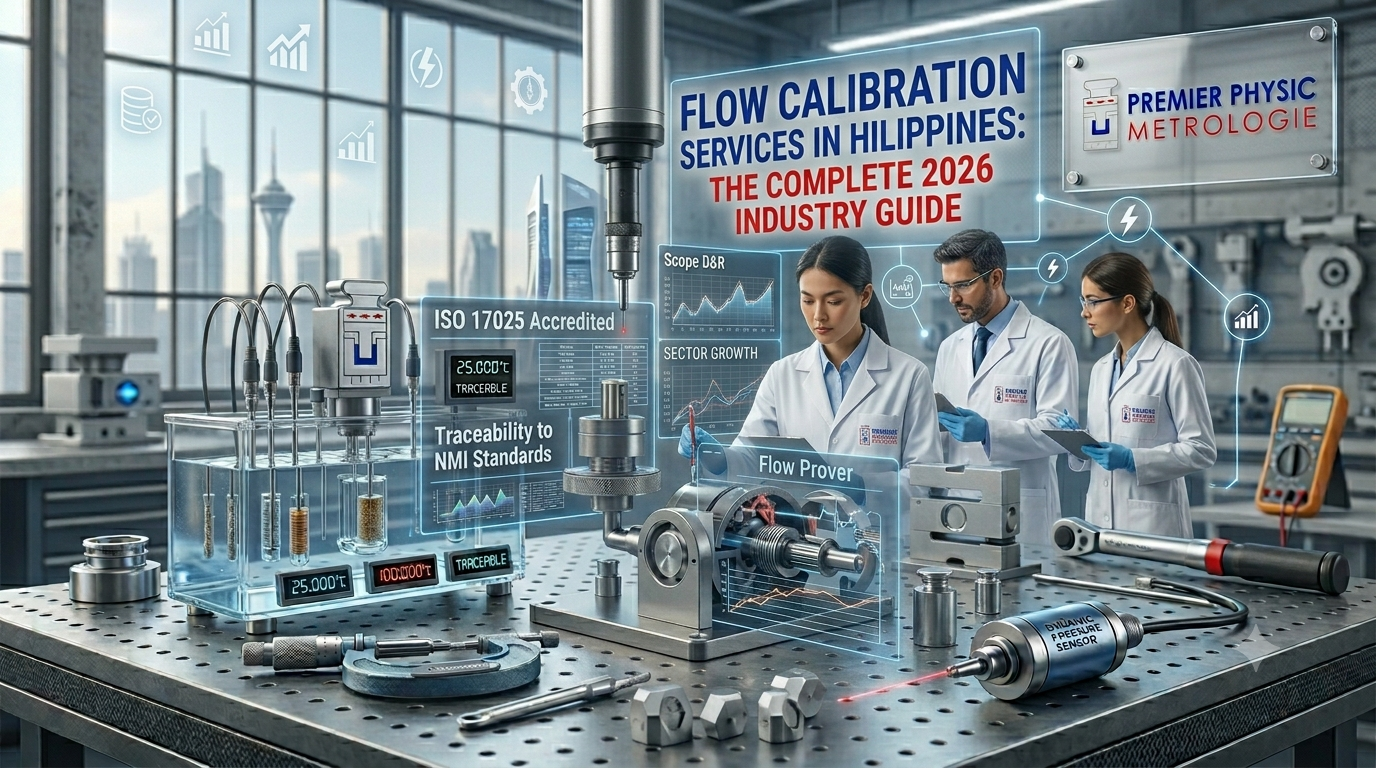
Flow measurement is one of the most commercially and operationally significant measurements in Philippine industry. Water utilities measure flow to bill consumers and account for losses in the distribution network. Oil and gas facilities measure the flow of hydrocarbons for custody transfer — transactions worth millions of pesos per day. Chemical plants control flow rates to maintain reaction stoichiometry and product quality. Pharmaceutical manufacturers measure the flow of purified water and process gases to critical specifications. Food and beverage processors control ingredient flow rates to maintain product formulation accuracy.
In every one of these applications, the accuracy of the flow measuring instrument directly affects commercial outcomes, product quality, and regulatory compliance. And accuracy, as with all measurements, is only verifiable through regular, traceable calibration.
Yet flow calibration remains one of the least understood calibration disciplines among Philippine quality managers and instrumentation engineers. Unlike temperature or pressure measurement, where the physical quantity is relatively intuitive, flow measurement involves complex interactions between fluid properties, pipe geometry, and measurement technology that make calibration both technically demanding and critically important.
This guide is the most comprehensive resource on flow calibration services in the Philippines for 2026. It covers what flow calibration is, the types of flow instruments that require it, the industries that depend on it, the regulatory frameworks that require it, how calibration is performed, what a compliant certificate contains, and why Premier Physic Metrologie (PPM Calibration) is the accredited flow calibration provider that Philippine industry trusts.
Section 1: What Is Flow Calibration?
The Technical Definition
Flow calibration is the process of comparing the output of a flow measuring instrument — the flow rate it indicates — against a known, traceable reference standard under controlled conditions at defined flow rates, documenting the difference between the indicated and true flow values, and — where required — adjusting the instrument to bring its readings within acceptable tolerance.
Flow is the quantity of fluid (liquid or gas) passing through a cross-section per unit time. It is measured in volumetric units (litres per minute, cubic metres per hour, gallons per day) or mass units (kilograms per hour, tonnes per day) depending on the application. The SI unit of volumetric flow rate is cubic metres per second (m³/s), though practical measurements are typically expressed in more convenient units.
Flow calibration traceability runs through volume measurement (for volumetric flow calibration) or mass measurement (for mass flow calibration) to the Philippine national measurement standards at ITDI-DOST and ultimately to the BIPM’s international realizations of the metre and kilogram.
Why Flow Accuracy Matters
The consequences of inaccurate flow measurement in Philippine industry span commercial, quality, safety, and regulatory dimensions:
- Custody transfer: When petroleum products, liquefied petroleum gas, or water are transferred between parties based on measured volume, inaccurate flow meters create billing errors — either overcharging customers or under-reporting transfers. In high-volume petroleum terminals, even a 0.1% flow meter error translates to millions of pesos in billing discrepancies per year.
- Pharmaceutical manufacturing: Mass flow controllers that inaccurately regulate the flow of process gases (nitrogen, carbon dioxide, compressed air) in pharmaceutical production equipment affect process conditions and potentially product quality. Purified water flow measurement inaccuracies affect formulation accuracy.
- Chemical processing: Chemical reaction stoichiometry depends on accurate reactant flow ratios. Inaccurate flow measurement produces off-specification products, wastes raw materials, and can create unsafe process conditions.
- Water utilities: Water distribution utilities in the Philippines measure flow to bill consumers and to detect non-revenue water (losses from leaks and theft). Inaccurate bulk meters mean either under-billing (revenue loss) or over-billing (customer complaints and regulatory risk).
- Environmental compliance: Industrial facilities in the Philippines must monitor and report discharge flow rates as part of DENR environmental compliance requirements. Inaccurate flow measurement can lead to under-reporting of actual discharge volumes — creating environmental liability.
Volumetric Flow vs. Mass Flow — Understanding the Distinction
Flow can be measured and reported as volumetric flow or mass flow — a distinction that matters for both instrument selection and calibration:
Volumetric flow: Measures the volume of fluid passing per unit time (e.g., L/min, m³/h). The volume of many fluids — particularly gases — varies with temperature and pressure. Volumetric flow meters measure volume at actual conditions. For custody transfer of gases, volumetric flow is typically corrected to standard conditions (standard cubic metres, or SCM) using temperature and pressure compensation.
Mass flow: Measures the mass of fluid passing per unit time (e.g., kg/h, t/day). Mass is not affected by temperature and pressure, making mass flow measurement more directly comparable across different process conditions. Coriolis flow meters and thermal mass flow controllers directly measure mass flow. For process control applications where reactant ratios matter — such as pharmaceutical and chemical manufacturing — mass flow measurement is often preferred.
Section 2: Flow Instruments That Require Calibration in the Philippines
Flow calibration applies to a wide range of instruments used across Philippine industry. Here is a comprehensive overview of the flow instrument types that PPM Calibration calibrates and their key applications.
Differential Pressure (DP) Flow Meters
Differential pressure flow meters are among the most widely used flow measurement devices in Philippine process industry. They measure flow indirectly by measuring the pressure drop across a primary element — an orifice plate, a venturi tube, a flow nozzle, or a wedge element — inserted in the process pipe. The pressure drop is related to the square of the flow velocity by well-established fluid dynamic relationships, allowing flow rate to be calculated from the differential pressure measurement.
DP flow meters are used extensively in oil and gas facilities, chemical plants, power generation, and water treatment throughout the Philippines. Their calibration typically involves verifying the performance of the differential pressure transmitter — which is calibrated as a pressure measurement instrument — along with verification of the primary element (orifice plate) dimensions and installation conditions.
Electromagnetic (Mag) Flow Meters
Electromagnetic flow meters — commonly called mag meters — measure the flow velocity of electrically conductive liquids by detecting the voltage induced in the liquid as it flows through a magnetic field. They are widely used in the Philippine water supply industry, wastewater treatment, and food and beverage processing for measuring clean water, wastewater, slurries, and conductive liquid products.
Mag meters are particularly popular in the Philippines because they have no moving parts (unlike mechanical meters), are unaffected by viscosity changes, and can measure flow in both directions. Their calibration verifies the accuracy of the flow indication across the instrument’s measurement range, typically using a traceable volumetric reference standard.
Ultrasonic Flow Meters
Ultrasonic flow meters measure flow velocity by timing the transmission of ultrasonic sound pulses between transducers — either across the pipe (transit-time meters) or using the Doppler effect for particulate-laden liquids. They are used in large-diameter pipeline applications in the Philippine water, oil and gas, and petrochemical sectors.
One significant advantage of clamp-on ultrasonic flow meters is that they can be attached to the outside of a pipe without requiring process shutdown or pipe cutting — making them valuable for temporary flow measurement and for flow verification on installed meters. Ultrasonic meter calibration verifies accuracy across the flow range using traceable reference flow standards.
Vortex Flow Meters
Vortex flow meters measure flow by detecting the frequency of vortices shed by a bluff body inserted in the flow stream — the vortex shedding frequency is proportional to the flow velocity. They are used in Philippine steam, gas, and liquid flow measurement applications, particularly in process industries where they offer robustness and relatively low maintenance requirements.
Vortex meters are calibrated by verifying the relationship between the measured vortex frequency and the actual flow rate, typically using a traceable volumetric or mass flow reference.
Rotameters (Variable Area Flow Meters)
Rotameters — also called variable area flow meters or VA meters — are simple, robust flow measurement instruments that display flow rate by the position of a float in a tapered tube. As flow increases, the float rises to a higher position in the tapered tube, displaying a higher flow reading on the scale. They are used in Philippine laboratories, pharmaceutical facilities, gas supply systems, and process monitoring applications.
Rotameter calibration verifies the accuracy of the float position reading against actual flow rate at multiple points across the measurement range, using the specific fluid and conditions for which the rotameter is calibrated. Rotameters are fluid-specific — a rotameter calibrated for water cannot be used directly for a denser or more viscous liquid without recalibration.
Mass Flow Controllers (MFCs)
Mass flow controllers are precision instruments used in pharmaceutical manufacturing, semiconductor fabrication, chemical research, and laboratory applications to measure and control the mass flow rate of gases with high accuracy. They combine a flow sensor with a proportional control valve to maintain a specified flow rate setpoint automatically.
MFC calibration verifies both the measurement accuracy (does the MFC read the correct flow rate?) and the control accuracy (does the MFC deliver the specified flow rate setpoint?). Calibration is performed using a traceable mass flow reference at multiple setpoint values across the instrument’s measurement range. MFCs are typically calibrated for a specific gas — a nitrogen-calibrated MFC cannot be used directly for a different gas without applying a gas correction factor.
Turbine and Positive Displacement Flow Meters
Turbine flow meters measure flow by counting the rotations of a turbine rotor placed in the flow stream — the rotation speed is proportional to the flow velocity. Positive displacement (PD) meters measure flow by repeatedly filling and emptying a measuring chamber of known volume. Both types are used in the Philippine petroleum, LPG, water, and food and beverage industries.
Turbine and PD meters are among the most accurate flow meters available for liquid flow measurement, making them common choices for custody transfer applications in the Philippines. Their calibration verifies the relationship between the meter’s pulse output and the actual volume passed, using a traceable volumetric reference system.
Coriolis Flow Meters
Coriolis flow meters measure mass flow and fluid density directly by detecting the Coriolis force generated by fluid flowing through vibrating tubes. They are the most accurate flow meters available for liquid mass flow measurement, and they are used in Philippine pharmaceutical, chemical, and food processing applications where mass flow measurement is required with the highest accuracy.
Coriolis meter calibration verifies mass flow accuracy and density measurement accuracy across the operating range of the instrument, using traceable mass and density reference standards.
Open Channel Flow Meters
Open channel flow meters measure the flow of liquids in open channels — rivers, irrigation canals, wastewater channels, and storm drains — where the liquid surface is exposed to the atmosphere. They typically work by measuring the water level in a primary element (weir, flume) and calculating flow from the level-flow relationship. They are used in Philippine irrigation systems, wastewater treatment plants, and environmental monitoring applications.
Open channel flow meter calibration verifies the accuracy of the level sensing element and the flow calculation against the theoretical or empirically determined level-flow relationship for the primary element type.
Section 3: Philippine Industries That Depend on Flow Calibration
Water Utilities and Treatment — MWSS, LWDs, and Private Concessionaires
The Philippine water supply sector — including the Metropolitan Waterworks and Sewerage System (MWSS), Local Water Districts (LWDs) throughout the country, and private water concessionaires — is one of the largest users of flow calibration services. Water utilities measure flow at multiple points in the distribution system: at source abstractions, at treatment plant influent and effluent, at pressure zone boundaries, and at consumer meters.
Accurate bulk flow measurement is essential for non-revenue water (NRW) management — identifying and reducing losses from leaks, illegal connections, and meter errors. MWSS and LWD concession agreements and regulatory requirements mandate that utility-grade flow meters be calibrated at defined intervals. Inaccurate bulk meters make NRW analysis impossible and undermine the investment efficiency of leak detection programs.
Consumer water meters — the meters that determine household and commercial water bills — are regulated by the Philippine National Water Resources Board (NWRB) and must meet accuracy requirements. Bulk custody transfer meters between utilities and concessionaires are particularly high-value calibration applications.
Oil, Gas, and Petroleum Products — Custody Transfer
Custody transfer flow measurement in the Philippine petroleum sector — covering crude oil, refined petroleum products, LPG, and natural gas — involves some of the highest-stakes flow calibration in the country. Custody transfer meters measure the volume of petroleum products transferred between producers, refiners, terminal operators, distributors, and retailers. With petroleum product prices in the range of tens to hundreds of pesos per litre, even small flow meter inaccuracies translate into significant commercial discrepancies.
The Department of Energy (DOE) and Bureau of Customs regulate petroleum product metering in the Philippines. Custody transfer meters must be calibrated using traceable standards and at intervals specified by regulatory requirements and commercial contracts. PPM Calibration’s pressure calibration scope — which supports DP flow meter calibration — and its traceable measurement capabilities serve the petroleum sector’s demanding accuracy requirements.
Pharmaceutical Manufacturing — Purified Water and Process Gas
Philippine pharmaceutical manufacturers use flow measurement extensively in the monitoring and control of purified water (PW) and water for injection (WFI) distribution systems, in the supply of process gases (nitrogen, compressed air, carbon dioxide) to manufacturing equipment, and in the measurement of liquid ingredients in formulation processes.
FDA Philippines GMP requirements mandate calibration of all manufacturing and quality control instruments, including flow measuring instruments in water systems and gas supply systems. Mass flow controllers in pharmaceutical manufacturing are particularly critical — they control the atmosphere inside reaction vessels, lyophilizers, and packaging equipment, where precise gas composition is essential for product quality.
Chemical and Petrochemical Processing
Chemical plants in Batangas, Laguna, and Metro Manila measure and control flow rates for reactant feed, product withdrawal, coolant circulation, and utility distribution. The accuracy of reactant flow measurement directly determines product yield, quality, and safety. In chemical reactions where stoichiometry is critical — polymer synthesis, fine chemical production — mass flow measurement accuracy can mean the difference between on-specification and off-specification product.
Process safety in chemical facilities also depends on accurate flow measurement. Emergency cooling water flow, purge gas flow, and deluge system flow rates are safety-critical parameters that require calibrated measurement instruments and documented calibration programs.
Food and Beverage Processing
Philippine food and beverage manufacturers use flow measurement for ingredient dosing (liquid sugar, vegetable oil, flavor compounds, water), filling line control, cleaning-in-place (CIP) chemical dosing, and utilities monitoring. The accuracy of ingredient flow measurement directly affects product formulation consistency and compliance with FDA Philippines labeling requirements for declared ingredients.
Beverage producers — carbonated soft drink manufacturers, juice processors, beer brewers — use flow meters to control ingredient blending ratios with high precision. An out-of-calibration flow meter on a sweetener dosing line produces batches with incorrect sugar content — a quality and labeling compliance issue.
Wastewater Treatment and Environmental Monitoring
Philippine industrial facilities with wastewater discharge permits are required under DENR regulations to monitor and report the volume of wastewater discharged. Flow meters in wastewater treatment plant influent and effluent streams provide the volume data needed for compliance reporting. Inaccurate flow meters produce inaccurate discharge volume data — creating environmental compliance risk.
The Philippine Clean Water Act (RA 9275) and DENR Administrative Orders require industrial wastewater dischargers to maintain flow monitoring equipment and submit discharge data to regulatory authorities. Calibrated flow measurement supports compliance with these requirements.
Power Generation and Utilities
Philippine power plants — thermal, geothermal, hydroelectric — use flow measurement extensively for fuel metering, cooling water management, steam flow measurement for turbine control, and feedwater flow monitoring in boilers. Fuel flow measurement in thermal power plants directly affects fuel cost accounting and environmental emission calculations (since emissions are typically calculated from fuel consumption).
Section 4: Regulatory Requirements for Flow Calibration in the Philippines
| Regulation / Standard | Who It Applies To | Flow Calibration Requirement |
| ISO 9001:2015 Clause 7.1.5 | All ISO 9001 certified organizations | Flow measuring instruments used in conformity evidence must be calibrated at specified intervals with traceable standards. |
| FDA Philippines GMP (Pharma) | Pharmaceutical manufacturers | All manufacturing instruments including flow meters in water systems and gas supply must be calibrated. Records maintained. |
| FDA Philippines GMP (Food) | Food manufacturers | Flow instruments in ingredient dosing and CIP systems must be calibrated for HACCP and GMP compliance. |
| DENR DAO Water Quality | Industrial wastewater dischargers | Flow meters used for DENR discharge volume reporting must be calibrated to ensure accurate compliance data. |
| DOE Petroleum Regulations | Petroleum product handlers | Custody transfer flow meters must meet DOE accuracy requirements. Calibration and verification required. |
| NWRB Water Utility Regulations | Water utilities and concessionaires | Bulk flow meters in water distribution must be calibrated. Consumer meter accuracy standards apply. |
| RA 9275 Clean Water Act | Industrial wastewater dischargers | Flow monitoring instruments must be maintained and calibrated for accurate wastewater volume reporting. |
| IATF 16949 | Automotive component manufacturers | All measuring instruments including flow meters in quality-critical applications must be calibrated with ISO/IEC 17025 certificates. |
Section 5: How Flow Calibration Is Performed
Reference Standards for Flow Calibration
Flow calibration reference standards are more complex than those used for static measurements like temperature or pressure, because flow is inherently dynamic — the fluid is moving during the calibration. The primary reference methods used for flow calibration are:
Gravimetric method: The most fundamental and accurate reference for liquid flow calibration. The fluid is diverted from the flow meter under test into a weighing vessel for a precisely timed period. The mass collected, divided by the collection time, gives the true mass flow rate. Using the fluid density (measured or known), the volumetric flow rate is calculated. This method is used for calibrating high-accuracy reference flow meters and for primary flow standards at national metrology institutes.
Volumetric method: Fluid is diverted into a calibrated collection vessel of known volume for a precisely timed period, giving the true volumetric flow rate. Simpler than the gravimetric method but slightly less accurate. Used for calibrating general industrial liquid flow meters.
Transfer standard method: The flow meter under test is connected in series with a calibrated reference flow meter. At each test flow rate, both meters are read simultaneously and the difference between them is the calibration error of the meter under test. This method allows calibration without a collection vessel and is practical for in-situ calibration of installed flow meters.
Sonic nozzle method (gas flow): For gas flow calibration, sonic nozzles generate a precisely defined gas flow rate based on the upstream pressure and temperature and the known geometry of the nozzle. This method is used for calibrating gas flow meters and mass flow controllers at traceable flow rates.
Key Calibration Parameters for Flow Meters
Flow calibration typically evaluates the following performance parameters:
- Accuracy / linearity: How closely the meter’s indicated flow matches the true flow across its measurement range. Typically evaluated at 5–10 test points from minimum to maximum flow.
- Repeatability: How consistently the meter gives the same reading for the same flow rate under the same conditions. Evaluated by repeated measurements at key flow rates.
- Rangeability (turndown ratio): The ratio of maximum to minimum flow at which the meter maintains its specified accuracy. A meter with 10:1 rangeability maintains accuracy from 10% to 100% of its full scale.
- Zero stability: For meters with electronic output, the stability of the zero reading when there is no flow. Zero drift can cause significant errors at low flow rates.
- Pressure drop: The pressure loss across the meter at operating flow rates — important for system design but not a calibration parameter per se.
In-Situ vs. Bench Calibration for Flow Meters
Flow meters present a unique calibration challenge: many are permanently installed in process piping and cannot be easily removed for laboratory calibration. Two approaches address this challenge:
Bench calibration (removal): The flow meter is removed from the pipe, transported to a flow calibration facility, and calibrated on a flow test rig using traceable reference standards. This provides the most accurate calibration but requires process shutdown and pipe reconnection, which can be costly for large process lines.
In-situ calibration (on-line): The flow meter is calibrated while installed in the process piping, using a portable transfer standard (reference flow meter) installed in series with the meter under test. This eliminates shutdown and recommissioning costs but relies on the accuracy of the portable reference standard and its installation.
PPM Calibration supports both approaches — laboratory bench calibration for portable flow instruments and smaller meters, and in-situ calibration using transfer standard methodology for installed meters in process lines. For clients in Metro Manila and Luzon, PPM’s onsite calibration team can perform in-situ flow calibration at the client facility.
Gas vs. Liquid Flow Calibration
Flow calibration for gases presents additional challenges compared to liquid flow calibration, because gas volume is significantly affected by temperature and pressure. Gas flow calibration must be performed at defined temperature and pressure conditions and the results expressed at standard reference conditions (typically 0°C and 1 atm, or 20°C and 1 atm, depending on the standard used). Mass flow calibration — which is independent of temperature and pressure — is the preferred approach for gas flow measurement in high-accuracy applications.
Liquid flow calibration is generally simpler because liquid volume is relatively insensitive to temperature and pressure at the conditions encountered in most Philippine industrial applications. However, for very-high-accuracy liquid flow calibration — such as custody transfer meters — temperature corrections for liquid density must be applied.
Section 6: Reading a Flow Calibration Certificate
A compliant ISO/IEC 17025:2017 flow calibration certificate from PPM Calibration contains specific technical information that your quality auditors and process engineers need. Here is what to look for.
Required Elements of a Flow Calibration Certificate
- Instrument identification: Make, model, serial number, nominal diameter, and tag number of the flow meter calibrated.
- Fluid calibrated with: The actual fluid used in calibration — water, air, nitrogen, or process fluid — and its temperature and density during calibration.
- Calibration conditions: Temperature, pressure, and viscosity of the calibration fluid — essential context for applying correction factors in the field.
- Calibration method: Reference to the procedure used — volumetric, gravimetric, or transfer standard method.
- Reference standard: The reference flow meter, volumetric vessel, or weighing system used, with its own traceability certificate number.
- Flow rates tested: The specific flow rates (or percentage of full scale) at which calibration was performed.
- Indicated readings: The flow meter’s readings at each test flow rate.
- Reference values: The true flow rates at each test point as determined by the reference standard.
- Error at each test point: The difference between indicated and reference values, expressed as a percentage of the indicated value or of the full scale.
- K-factor or meter factor (where applicable): For pulse-output meters, the factor relating pulse count to volume — verified or corrected by calibration.
- Measurement uncertainty: Expressed as ±% with coverage factor at each test point — the scientific quantification of calibration result validity.
- Traceability statement: Linking results through the reference standard to ITDI-DOST and BIPM.
- Authorized metrologist signature: Confirming technical review and approval.
Understanding Flow Meter Error Expressions
Flow calibration errors are typically expressed in one of two ways — and understanding the difference is important for evaluating whether an instrument meets its specification:
Percentage of reading (%R): The error is a fixed percentage of the actual flow rate being measured. A ±1% of reading specification means the error is 1% of whatever the actual flow is — 0.1 L/min error at 10 L/min, 1 L/min error at 100 L/min. Most electronic flow meters (mag meters, Coriolis, ultrasonic) specify accuracy as % of reading.
Percentage of full scale (%FS): The error is a fixed percentage of the meter’s maximum range, regardless of the actual flow. A ±1% FS specification on a 100 L/min meter means ±1 L/min error at all flow rates — which is 10% of reading at 10 L/min. %FS accuracy specifications penalise the user at low flow rates and should be carefully considered for applications with wide flow rate variation.
| Practical Tip for Philippine Quality Engineers: When comparing flow meter accuracy specifications from different manufacturers, always check whether the accuracy is expressed as %reading or %full scale. A meter specified at ±0.5% FS may actually be less accurate at low flow rates than one specified at ±1.0% of reading. PPM Calibration can help you evaluate flow meter performance data and determine whether instruments meet your process requirements. |
Section 7: Flow Calibration Intervals in the Philippines
Factors Affecting Flow Meter Calibration Interval
Flow meters present unique calibration interval challenges because their accuracy is affected not only by time but also by the process fluid they measure — contamination, scaling, erosion, and corrosion can all affect flow meter performance between calibrations. Additional factors specific to flow meter calibration interval include:
- Fluid characteristics: Corrosive fluids, scaling fluids, and abrasive slurries degrade flow meter accuracy faster than clean water or clean gas
- Flow profile: Turbulent or disturbed flow profiles caused by upstream elbows, valves, or reducers can affect meter reading, particularly for single-path ultrasonic and differential pressure meters
- Process conditions: High temperatures and pressures accelerate wear on mechanical flow meters
- Meter type: Mechanical meters (turbine, PD) are more susceptible to wear-related accuracy drift than electronic meters (mag, ultrasonic, Coriolis)
- Application criticality: Custody transfer meters require shorter intervals than general process monitoring meters
Recommended Flow Calibration Intervals
| Flow Meter Type / Application | Recommended Interval | Key Consideration |
| Custody transfer meters (petroleum) | 6–12 months or per contract | DOE/commercial contract may specify shorter interval |
| Water utility bulk meters | 12 months or per NWRB requirement | Short interval for high-value metering points |
| Pharmaceutical PW/WFI flow meters | 12 months | FDA GMP requirement — shorter if fouling occurs |
| Mass flow controllers (pharma/lab) | 12 months | Verify gas-specific calibration at each service |
| Chemical dosing flow meters | 6–12 months | Short interval for corrosive or fouling service |
| Food ingredient flow meters | 12 months | Verify calibration with actual process fluid |
| Process flow meters (general industry) | 12 months | Shorter for mechanical meters in harsh service |
| Wastewater flow meters (DENR compliance) | 12 months | DENR reporting accuracy requirement |
| Open channel flow meters | 12 months | Inspect primary element for debris and damage |
| Reference / portable flow calibrators | 12 months | High priority — used to calibrate other meters |
Section 8: PPM Calibration — The Philippines’ Trusted Flow Calibration Provider
25 Years of Flow Calibration Experience in the Philippines
Premier Physic Metrologie has been providing ISO/IEC 17025 accredited flow calibration services to Philippine industry for 25 years. In that time, PPM’s flow calibration team has served water utilities across the Philippines, pharmaceutical manufacturers in Metro Manila and Laguna, oil and gas facilities in Batangas, chemical processors, food and beverage manufacturers, and environmental monitoring operations. This 25-year experience represents an unmatched depth of flow calibration knowledge in the Philippine context.
PPM’s flow calibration metrologists understand the specific challenges of flow measurement in the Philippines: the quality of Philippine process water and its effect on meter performance, the regulatory requirements of DOE, NWRB, and DENR, the FDA Philippines documentation requirements for pharmaceutical flow instruments, and the practical challenges of calibrating installed flow meters in process facilities across Luzon.
ISO/IEC 17025:2017 PAB-DAP Accredited Flow Calibration
PPM Calibration’s flow calibration services are performed under its current ISO/IEC 17025:2017 PAB-DAP accreditation. Every flow calibration certificate PPM issues includes:
- Full measurement traceability to ITDI-DOST and BIPM through PPM’s flow reference standard chain
- Measurement uncertainty at every test point calculated per GUM methodology
- Complete calibration results at multiple test points across the flow range
- Calibration fluid identification and conditions — essential for applying field corrections
- PAB-DAP accreditation mark and ILAC MRA combined mark — accepted internationally
- Authorized metrologist signature — confirming technical review and approval
PPM Calibration’s Flow Calibration Scope
| Flow Instrument Type | PPM Calibration Service |
| Electromagnetic (mag) flow meters | Liquid flow calibration — water and conductive liquids |
| Rotameters (variable area meters) | Liquid and gas rotameter calibration — multiple fluid types |
| Mass flow controllers (MFCs) | Gas MFC calibration — multiple gas types with correction factors |
| Turbine flow meters | Liquid and gas turbine meter calibration |
| Positive displacement meters | Liquid PD meter calibration — petroleum and water |
| Differential pressure elements | DP transmitter calibration (as part of pressure calibration scope) |
| Ultrasonic flow meters | Portable and installed ultrasonic meter calibration |
| Vortex flow meters | Liquid and gas vortex meter calibration |
| Portable flow calibrators | Reference flow calibrator calibration and verification |
Laboratory and Onsite Flow Calibration
Laboratory flow calibration: Portable flow instruments — rotameters, mass flow controllers, portable flow meters — are brought to PPM’s laboratory for calibration using traceable flow reference systems in a controlled environment. Laboratory calibration provides the best achievable measurement uncertainty for flow instruments.
Onsite flow calibration: For installed flow meters that cannot be removed from process piping without shutdown, PPM’s mobile calibration team performs in-situ flow calibration using portable transfer standard flow meters. Onsite flow calibration is available throughout Metro Manila, Luzon, and for large projects, other regions of the Philippines. This service minimises process disruption while delivering ISO/IEC 17025 accredited calibration results at your facility.
Combined Flow Calibration with Other Disciplines
Many Philippine process facilities need both flow calibration (for flow meters) and pressure calibration (for differential pressure transmitters that support DP flow measurement) in the same instrument campaign. PPM Calibration’s broad accredited scope — covering flow, pressure, temperature, electrical, weight, torque, and force calibration — allows clients to address all instrument calibration needs in a single coordinated campaign, reducing administrative complexity and mobilization cost.
Section 9: Frequently Asked Questions — Flow Calibration in the Philippines
Q: What is flow calibration and why is it required in the Philippines?
A: Flow calibration is the process of verifying that flow measuring instruments — flow meters, rotameters, mass flow controllers — accurately measure the flow rate of liquids or gases. It is required in the Philippines because ISO 9001 Clause 7.1.5, FDA Philippines GMP, DENR environmental regulations, DOE petroleum metering requirements, and NWRB water utility regulations all mandate calibrated flow measurement in relevant applications. Beyond compliance, accurate flow measurement is essential for product quality, commercial billing accuracy, process efficiency, and environmental compliance.
Q: How often should flow meters be calibrated in the Philippines?
A: Most flow meters in general industrial applications should be calibrated annually. Custody transfer flow meters — used for petroleum product or water billing — may require 6-month calibration intervals or calibration intervals specified in commercial contracts or regulatory requirements. Flow meters measuring corrosive, scaling, or abrasive fluids may need more frequent calibration due to accelerated meter wear. Flow meters in pharmaceutical purified water systems should be calibrated annually at minimum per FDA Philippines GMP requirements. PPM Calibration provides free consultation on flow meter calibration interval determination.
Q: Can PPM Calibration calibrate our flow meters without shutting down the process line?
A: For many installed flow meters, yes. PPM Calibration’s onsite flow calibration service uses portable transfer standard flow meters that can be temporarily installed in series with the meter under test, allowing in-situ calibration without removing the meter from the process line. Whether shutdown is required depends on the meter type, pipe size, and installation conditions. Contact PPM Calibration to discuss the specific requirements for your installed meters.
Q: What fluid should be used for flow meter calibration?
A: Ideally, flow meters should be calibrated using the same fluid they measure in service. Most flow meters are calibrated using clean water for liquid meters or clean dry air or nitrogen for gas meters, with results corrected to actual process fluid conditions using the fluid density and viscosity. For mass flow controllers, gas-specific calibration is essential.
Q: What is a K-factor in flow meter calibration?
A: The K-factor (or meter factor) is a conversion factor used with pulse-output flow meters — particularly turbine meters and oval gear meters — to relate the number of pulses generated per unit volume. For example, a turbine meter with a K-factor of 1000 pulses/litre generates 1000 pulse signals for each litre that passes through. Calibration verifies the K-factor across the flow range and may identify a corrected K-factor value to apply in the flow computer or totalizer if the as-found K-factor has drifted from its specified value. Custody transfer meters must have their K-factors verified by calibration at defined intervals.
Q: Does PPM Calibration calibrate mass flow controllers for pharmaceutical use?
A: Yes. PPM Calibration provides calibration of mass flow controllers (MFCs) used in pharmaceutical manufacturing — including MFCs in nitrogen blanketing systems, lyophilizer gas supply, packaging equipment, and analytical instruments. MFC calibration is performed using traceable gas flow reference standards for the specific gas type the controller is used with. All calibration certificates include measurement uncertainty data and traceability statements that satisfy FDA Philippines GMP documentation requirements.
Q: How do I request flow calibration services from PPM Calibration?
A: Visit ppmcalibration.com/request-a-quote and provide your instrument list — including flow meter types, nominal sizes, flow ranges, fluid types, and your facility location. For onsite calibration of installed meters, also describe the installation conditions and access requirements. PPM Calibration will confirm scope coverage, provide a detailed quotation, and schedule your calibration. All initial consultations are free. Contact PPM through the website or Facebook at facebook.com/ppmcalab.
Conclusion: Flow Calibration Is the Foundation of Accurate Fluid Measurement in the Philippines
Flow measurement touches nearly every aspect of Philippine industry — from the water we drink to the fuel that powers our vehicles, from the pharmaceutical ingredients that keep patients healthy to the chemical reactions that produce the materials our economy depends on. In every application, the accuracy of the flow meter determines whether the measurement serves its purpose: controlling a process, billing a customer, demonstrating environmental compliance, or ensuring product quality.
Flow calibration is how accuracy is verified, documented, and maintained. Without it, flow measurement is just an indication — a number on a display with no verified connection to physical reality. With ISO/IEC 17025 accredited calibration from PPM Calibration, flow measurement becomes documented, traceable, uncertainty-quantified evidence — acceptable to auditors, regulators, customers, and the demands of quality management.
Premier Physic Metrologie (PPM Calibration) has spent 25 years building the flow calibration expertise, the accredited capability, and the client trust to serve Philippine industry’s demanding flow measurement needs. From water utility bulk meters to pharmaceutical mass flow controllers, from rotameters in laboratory gas supply systems to turbine meters in petroleum custody transfer — PPM Calibration delivers flow calibration that Philippine businesses can flow with confidence.
| Ready to schedule flow calibration for your Philippine facility? Visit ppmcalibration.com/flow-calibration-services or request a free quote at ppmcalibration.com/request-a-quote. PPM Calibration — 25 years of flow calibration excellence in the Philippines. ISO/IEC 17025:2017 accredited. Nationwide service. |
| About the AuthorThis article was produced by Premier Physic Metrologie, Incorporated (PPM Calibration) — an ISO/IEC 17025:2017 accredited calibration laboratory in the Philippines with 25 years of experience providing flow calibration services to water treatment, oil and gas, pharmaceutical, chemical, and industrial clients nationwide.Website: ppmcalibration.com | Facebook: @ppmcalab | Instagram: @ppmcalab | LinkedIn: Premier Physic Metrologie |