Pressure is one of the most critical and most frequently measured parameters in Philippine industry. It governs the safety of steam systems in pharmaceutical autoclaves. It controls the process conditions in petrochemical reactors in Batangas. It determines whether hydraulic systems in construction equipment are operating within safe limits. It monitors the integrity of food and beverage processing lines in Bulacan and Laguna. It protects workers in confined spaces from dangerous pressure build-up.
Across all of these applications, the instruments that measure pressure — gauges, transducers, transmitters, manometers, and vacuum gauges — must be accurate. And accuracy can only be verified through regular, traceable calibration by a competent accredited laboratory.
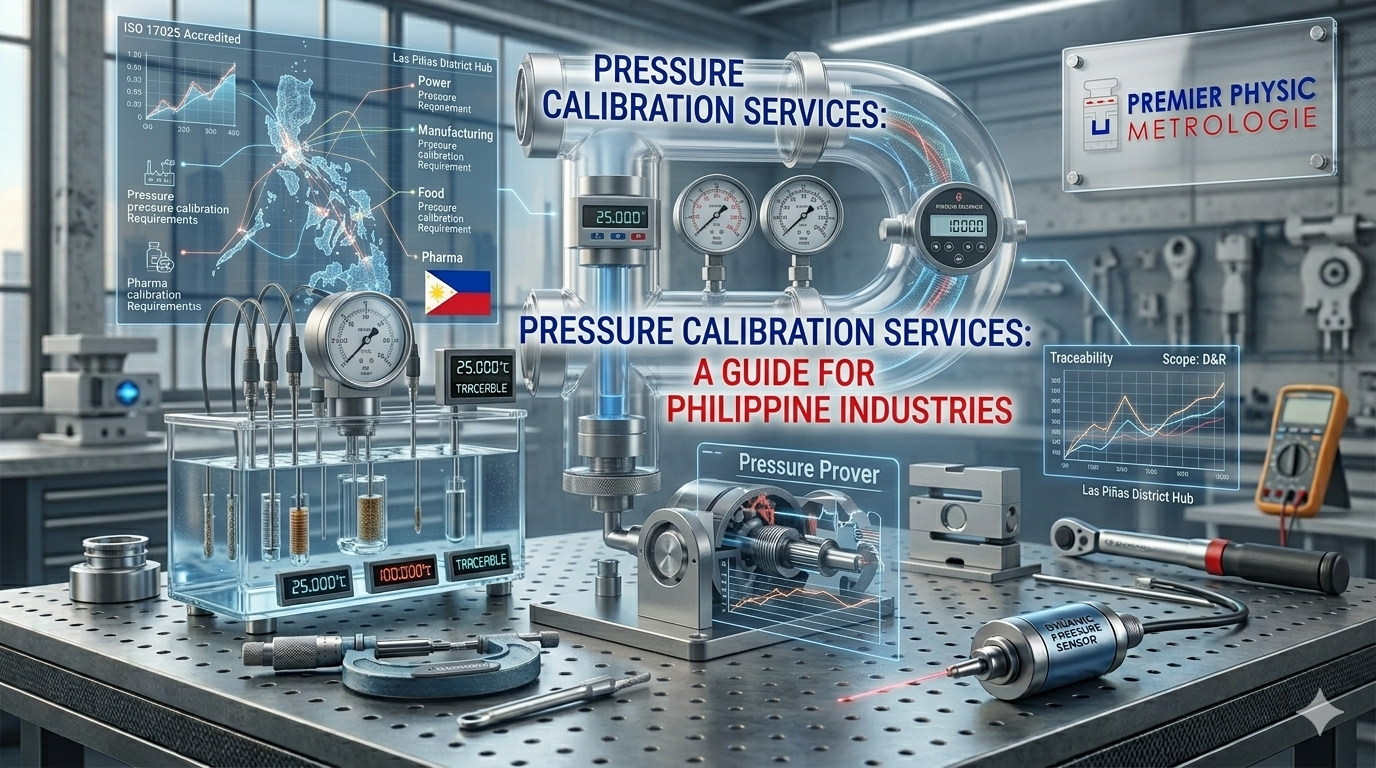
This guide is the most comprehensive resource on pressure calibration services in the Philippines for 2026. It explains what pressure calibration is, which instruments require it, which Philippine industries depend on it most, what the regulatory requirements are, how pressure calibration is performed, and how Premier Physic Metrologie (PPM Calibration) delivers ISO/IEC 17025 accredited pressure calibration to clients nationwide. If you are responsible for a calibration program, a quality management system, or safety compliance at a Philippine facility that uses pressure measurement — this guide is written for you.
Section 1: What Is Pressure Calibration?
The Technical Definition
Pressure calibration is the process of comparing the output of a pressure-measuring instrument against a known, traceable reference standard at defined pressure values, documenting the difference between the instrument’s reading and the true pressure, and — where required — adjusting the instrument to bring its readings within acceptable tolerance.
The reference standards used in pressure calibration must themselves be calibrated and traceable to national measurement standards. In the Philippines, pressure calibration traceability runs from the calibrating laboratory’s reference standards through the Industrial Technology Development Institute (ITDI-DOST) — the Philippines’ national metrology institute — and ultimately to the International Bureau of Weights and Measures (BIPM) in France, which defines the Pascal as the SI unit of pressure.
Pressure Units and Measurement Types in Philippine Industry
Pressure can be expressed in multiple units and measured in several reference modes. Understanding these distinctions is important for specifying and interpreting pressure calibration correctly.
| Pressure Concept | Definition and Philippine Application |
| Gauge pressure (psig, bar g, kPag) | Measured relative to ambient atmospheric pressure. Most common in Philippine industrial applications — boiler pressure, compressed air, hydraulic systems. |
| Absolute pressure (psia, bar a, kPaa) | Measured relative to perfect vacuum (zero pressure). Used in vacuum processes, barometric measurement, and some analytical instruments. |
| Differential pressure (psid, bar d) | Difference between two pressure points. Used in flow measurement (orifice plates), filter condition monitoring, and level measurement. |
| Vacuum (torr, mbar, Pa) | Pressure below atmospheric. Used in pharmaceutical, semiconductor, and chemical processes requiring sub-atmospheric conditions. |
| Pascal (Pa), kPa, MPa | SI units — used in scientific and engineering calculations. 1 bar ≈ 100 kPa ≈ 14.5 psi. |
| psi (pounds per square inch) | Common in legacy equipment, US-sourced instruments, and some Philippine industrial applications. |
| bar | Common in European-sourced equipment widely used in Philippine manufacturing and process industries. |
Why Pressure Accuracy Is a Safety and Quality Imperative
Unlike some measurement parameters where inaccuracy results primarily in product quality issues, inaccurate pressure measurement can have immediate safety consequences. A pressure relief valve that activates at the wrong pressure, a boiler pressure gauge that under-reads, or a pressure transmitter that fails to detect an overpressure condition — these are not quality problems. They are safety failures with potential consequences including equipment damage, process upsets, fires, explosions, and injury.
In the Philippines, where many process industry facilities operate aging pressure systems and where safety enforcement has historically been inconsistent, properly calibrated pressure instruments are among the most important elements of any facility safety program. And in quality-regulated industries, inaccurate pressure measurement results in out-of-specification products, failed audits, and regulatory enforcement.
| Key Point: Pressure calibration is not just a compliance exercise — it is a safety requirement. In industries where pressure measurement is safety-critical, out-of-calibration pressure instruments represent an unacceptable operational risk. ISO/IEC 17025 accredited pressure calibration from PPM Calibration provides the verified accuracy and documented traceability that safety and quality programs demand. |
Section 2: Pressure Instruments That Require Calibration in the Philippines
Pressure calibration applies to a wide range of instruments used across Philippine industry. Here is a comprehensive overview of the instrument types that PPM Calibration regularly calibrates.
Pressure Gauges
The pressure gauge — a circular dial instrument with a pointer indicating pressure on a scale — is the most ubiquitous pressure instrument in Philippine industry. Bourdon tube gauges, diaphragm gauges, and capsule gauges are found on boilers, compressors, hydraulic systems, gas cylinders, water supply systems, autoclaves, and process vessels throughout the country.
Pressure gauges are subject to mechanical wear, Bourdon tube fatigue, and calibration drift — particularly those in high-cycle applications where pressure fluctuates frequently. Regular calibration is essential to ensure that gauge readings accurately reflect actual system pressure. A gauge that reads 10 psi low on a steam system operating near its design limit may fail to trigger a safety response that would otherwise prevent an overpressure incident.
Pressure Transducers and Transmitters
Pressure transducers and transmitters convert pressure into an electrical signal — typically 4-20 mA current, 0-10V voltage, or digital communication — that is processed by a control system, data logger, or display. These instruments are the backbone of modern process control in Philippine manufacturing and chemical facilities, where accurate pressure signals drive automated control loops that maintain product quality and process safety.
Pressure transducer calibration verifies the accuracy of the electrical output signal against the applied pressure, across the instrument’s full measurement range. Because transducers are typically part of automated control systems, their calibration has a direct impact on process control accuracy — an out-of-calibration transmitter generates inaccurate process data that can lead to product quality deviations and, in safety-critical applications, to dangerous process conditions.
Manometers
Manometers measure pressure using the displacement of a liquid column — typically mercury or water — and are used in laboratory and reference applications where high accuracy is required. Digital manometers are increasingly used as portable reference instruments for field pressure measurement and as working standards in calibration laboratories.
In Philippine calibration laboratories and reference measurement applications, digital precision manometers serve as working reference standards for calibrating field pressure instruments. These manometers themselves must be regularly calibrated against higher-level reference standards to maintain their measurement validity.
Pressure Controllers and Calibrators
Pressure calibrators are specialized instruments used to generate, control, and measure precise pressure values for the purpose of calibrating other pressure instruments. High-accuracy pressure calibrators used by calibration laboratories — including PPM Calibration’s reference equipment — must themselves be calibrated at regular intervals against primary pressure standards to maintain traceability.
Vacuum Gauges
Vacuum gauges measure pressures below atmospheric and are used in pharmaceutical manufacturing, semiconductor fabrication, chemical processing, and laboratory applications throughout the Philippines. Common types include mechanical vacuum gauges (Pirani, thermocouple, Penning), capacitance manometers, and digital vacuum transmitters.
Vacuum gauge calibration verifies instrument accuracy in the sub-atmospheric pressure range — a measurement domain that requires different reference equipment and methods than positive pressure calibration. PPM Calibration’s pressure and vacuum calibration scope covers both positive pressure and vacuum ranges.
Differential Pressure Instruments
Differential pressure (DP) instruments measure the difference between two pressure points and are widely used in Philippine industry for flow measurement using orifice plates and venturi tubes, for monitoring filter pressure drop to determine when filters need replacement, and for level measurement using hydrostatic pressure relationships.
DP transmitter calibration verifies that the instrument correctly measures the difference between its high and low pressure inputs across its full measurement range. Because DP instruments are often used in flow measurement that directly affects product quantity billing or process control, their calibration accuracy has direct commercial and quality implications.
Pressure Relief Valves — Calibration and Testing
While pressure relief valves (PRVs) are not instruments in the traditional sense, they require periodic testing and setting verification to ensure they activate at the correct pressure. PRV testing verifies that the valve opens at its specified set pressure and closes properly after pressure relief. In safety-instrumented systems, PRV testing is a regulatory requirement under process safety management frameworks.
Section 3: Philippine Industries That Depend on Pressure Calibration
Oil, Gas, and Petrochemical — Batangas and Luzon Industrial Zones
The Philippine petrochemical and oil and gas sector — centered on the Batangas petrochemical complex, the Limay refinery in Bataan, and petroleum product distribution infrastructure nationwide — is among the most demanding users of pressure calibration services. Process vessels, pipelines, compressors, pumps, heat exchangers, and safety systems all rely on accurate pressure measurement for process control and safety.
Pressure calibration in oil and gas facilities must meet stringent requirements: instruments must be traceable, documented, and calibrated at intervals that satisfy both quality management standards and process safety management requirements. Safety instrumented systems (SIS) — which monitor process conditions and trigger emergency shutdowns when dangerous conditions are detected — require particularly rigorous calibration programs under standards such as IEC 61511.
Chemical Processing
Chemical manufacturing facilities in Batangas, Laguna, and Metro Manila use pressure measurement extensively in reactor control, distillation column management, pump and compressor monitoring, and safety system operation. Process chemistry often requires precise pressure control to achieve desired reaction conditions and product quality.
In the chemical industry, pressure calibration is not only a quality requirement — it is directly linked to process safety. Reactions that are temperature and pressure sensitive can become uncontrollable if pressure measurement is inaccurate and the control system receives false data. Regular, traceable pressure calibration is a fundamental element of chemical plant safety management.
Pharmaceutical Manufacturing — Autoclaves and Cleanrooms
Philippine pharmaceutical manufacturers use pressure instruments in several critical applications. Autoclaves — the steam sterilization equipment central to pharmaceutical manufacturing — rely on pressure gauges and transmitters to verify that sterilization conditions are achieved and maintained. Cleanroom differential pressure monitoring ensures that controlled environments maintain the pressure differentials required to prevent contamination.
FDA Philippines GMP requirements mandate calibration of all manufacturing and quality control instruments, including pressure instruments in sterilization, cleanroom monitoring, and process control applications. Pharmaceutical pressure calibration certificates must come from ISO/IEC 17025 accredited laboratories to satisfy FDA inspection requirements.
Food and Beverage Processing
Food processing facilities throughout the Philippines use pressure instruments in retort sterilization, homogenization, pasteurization, filling line pressure control, and compressed air and gas supply monitoring. The accuracy of pressure measurement in retort sterilizers — which use steam pressure to achieve the temperatures required for commercial sterilization of canned and packaged food products — is directly related to food safety.
Under FDA Philippines GMP and HACCP requirements, pressure instruments at critical control points in food processing must be calibrated at defined intervals. A retort pressure gauge that under-reads by 5 psi may indicate that sterilization conditions are met when they are not — with potentially serious food safety consequences.
Manufacturing and Engineering
Philippine manufacturers across diverse sectors — automotive components, electronics, metal fabrication, plastics, rubber, and textiles — use pneumatic and hydraulic systems controlled by pressure instruments. ISO 9001 Clause 7.1.5 requires calibration of all measuring equipment used to provide evidence of conformity, which includes pressure gauges used in quality control testing, pneumatic assembly tools, and hydraulic testing equipment.
IATF 16949 certified automotive component manufacturers face additional requirements for pressure calibration — all gauges and test equipment used in quality control must be calibrated with ISO/IEC 17025 accredited certificates, and measurement system analysis may be required for pressure measurement systems used in product acceptance decisions.
Utilities and Water Treatment
Water utilities, wastewater treatment plants, and industrial water systems throughout the Philippines use pressure instruments extensively in pumping systems, filtration systems, and distribution network monitoring. Accurate pressure measurement is essential for efficient operation, leak detection, and compliance with water quality and distribution standards.
Construction and Structural Engineering
Construction projects in Metro Manila and across the Philippines use hydraulic pressure systems in lifting equipment, concrete pumping, pile driving, and post-tensioning systems. Pressure gauges on hydraulic jacks used for post-tensioning prestressed concrete structures must be calibrated to ensure that the correct tendon forces are applied — an engineering safety requirement.
Section 4: Regulatory Requirements for Pressure Calibration in the Philippines
| Regulation / Standard | Who It Applies To | Pressure Calibration Requirement |
| ISO 9001:2015 Clause 7.1.5 | All ISO 9001 certified organizations | All measuring equipment — including pressure instruments — must be calibrated at specified intervals with traceable standards. Records maintained. |
| IATF 16949 | Automotive component manufacturers | All gauges and test equipment calibrated. ISO/IEC 17025 certificates required. MSA for measurement systems in product acceptance. |
| FDA Philippines GMP (Pharma) | Pharmaceutical manufacturers | All manufacturing and QC pressure instruments calibrated. Autoclave pressure gauges specifically covered. |
| FDA Philippines GMP (Food) | Food manufacturers and processors | Pressure instruments at CCPs — including retort sterilizers — must be calibrated. HACCP monitoring equipment covered. |
| IEC 61511 (Process Safety) | Process industry with Safety Instrumented Systems | Pressure instruments in SIS must be tested and calibrated at defined intervals determined by safety integrity level requirements. |
| DOLE OSHS / RA 11058 | Employers with pressure systems | Pressure vessels and associated instruments subject to DOLE inspection. Calibrated pressure instruments support compliance. |
| ASME Boiler & Pressure Vessel Code | Facilities with pressure vessels and boilers | Pressure relief valve testing and pressure gauge calibration required for code compliance. |
| ISO 14001 / ISO 45001 | Environmental and safety certified organizations | Monitoring instruments — including pressure instruments relevant to environmental emissions or safety — must be calibrated. |
Section 5: How Pressure Calibration Is Performed — Methods and Equipment
Deadweight Testers — The Primary Reference for Pressure Calibration
The deadweight tester (also called a piston gauge or pressure balance) is the most accurate primary reference instrument for pressure calibration. It works by applying precisely known weights to a piston of known area, generating a precisely calculated pressure that serves as the reference against which other pressure instruments are compared.
Deadweight testers generate pressure that is directly calculable from fundamental physical quantities — mass, gravitational acceleration, and area — making them primary measurement standards with the lowest measurement uncertainty achievable for pressure calibration. PPM Calibration’s reference standards include deadweight testers calibrated at ITDI-DOST, forming the primary traceability link in PPM’s pressure calibration chain.
Pressure Comparators
Pressure comparators generate a controlled pressure using a hydraulic or pneumatic system and allow simultaneous measurement by both a reference standard and the instrument being calibrated. The comparator does not itself generate a known pressure — it simply provides a stable, adjustable pressure source that allows the reference and the test instrument to be compared under identical conditions.
Pressure comparators are widely used in calibration laboratories for calibrating pressure gauges, transducers, and transmitters across a range of pressure values. They are particularly useful for calibrating instruments that require multiple test points across their full measurement range.
Digital Pressure Calibrators — For Onsite Calibration
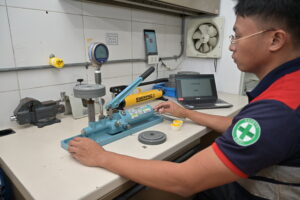
Digital pressure calibrators are portable, high-accuracy instruments that combine a pressure generation system and a precision reference measurement in a single unit. They are the primary tool for onsite pressure calibration — brought to client facilities by PPM Calibration’s mobile team to calibrate installed pressure instruments without removing them from service.
Modern digital pressure calibrators achieve measurement uncertainties comparable to laboratory-based comparator systems for the pressure ranges most commonly encountered in Philippine industrial applications. PPM Calibration’s portable digital pressure calibrators are themselves regularly calibrated against PPM’s laboratory reference standards, ensuring full traceability for all onsite pressure calibrations.
Pressure Calibration Range Capabilities at PPM Calibration
| Pressure Range | Instruments Typically Calibrated |
| Vacuum to -1 bar (negative gauge) | Vacuum gauges, vacuum transmitters, suction pressure instruments |
| 0 to 1 bar gauge | Low-pressure gauges, manometers, water pressure instruments, cleanroom DP instruments |
| 0 to 10 bar gauge | General industrial pressure gauges, autoclave pressure gauges, pneumatic system gauges |
| 0 to 100 bar gauge | High-pressure industrial systems, hydraulic gauges, compressed gas gauges |
| 0 to 1000 bar gauge | Very high-pressure applications — hydraulic testing, oil and gas wellhead equipment |
| Differential pressure | Flow measurement DP transmitters, filter DP monitors, level measurement systems |
| Absolute pressure | Barometric instruments, vacuum and process analytical instruments |
For specific pressure range and uncertainty requirements beyond those listed above, contact PPM Calibration at ppmcalibration.com to confirm scope coverage and receive a customized quotation.
Section 6: What a Compliant Pressure Calibration Certificate Looks Like
A pressure calibration certificate from an ISO/IEC 17025 accredited laboratory contains specific technical information that documents the calibration result and provides the evidence your auditors, regulators, and quality managers need. Here is what to look for.
Required Elements of an ISO/IEC 17025 Pressure Calibration Certificate
- Instrument identification: Make, model, serial number, and tag number of the pressure gauge, transducer, or manometer calibrated.
- Calibration date: The date on which calibration was performed — critical for tracking calibration due dates.
- Calibration method: Reference to the procedure or standard used — for example, an internal PPM procedure referenced by number.
- Reference standard identification: The deadweight tester, pressure comparator, or digital calibrator used as the reference, with its own calibration certificate number and traceability details.
- Applied pressure values (test points): The specific pressures at which the calibration was performed — typically at minimum 5 test points across the instrument’s range.
- As-found readings: The instrument’s actual readings at each test point before any adjustment — showing actual performance before calibration intervention.
- As-left readings: The instrument’s readings after any adjustment — confirming performance at certificate issue.
- Measurement uncertainty: Expressed as ±X Pa / kPa / bar / psi with coverage factor (typically k=2) at each test point — the most technically critical element.
- Traceability statement: Explicitly links calibration results to ITDI-DOST and BIPM through the reference standard chain.
- Authorized signature: Signed by the responsible metrologist — confirming technical review and approval.
Understanding Pressure Calibration Results — As-Found and As-Left
The as-found data on a pressure calibration certificate tells you how the instrument was actually performing when the metrologist arrived. This information is critical for retrospective quality assurance: if a pressure gauge was significantly out of tolerance, the quality manager needs to know whether products, processes, or safety systems that relied on that gauge during the period since its last calibration may have been affected.
The as-left data tells you how the instrument is performing at the time the certificate is issued — after any adjustments. If the as-left readings show the instrument is within its specified accuracy tolerance, it is returned to service. If adjustment was not possible and the instrument remains out of tolerance, the certificate should clearly note this — and the instrument should be removed from service and repaired or replaced.
| Critical reminder: A pressure calibration certificate that shows only ‘PASS’ without actual measurement data at each test point does not comply with ISO/IEC 17025:2017. A compliant certificate always shows the actual readings — both before and after adjustment — at every calibration point, along with measurement uncertainty values. PPM Calibration’s certificates always include complete measurement data. |
Section 7: Pressure Calibration Intervals — How Often Is Right for Your Industry?
Determining the Right Interval
The appropriate pressure calibration interval depends on the instrument type, its application, its criticality, the environment in which it operates, and its historical calibration performance. There is no single universal answer — but there are established guidelines for Philippine industry that provide a strong starting point.
Instruments in harsh environments — high temperature, vibration, corrosive media — drift faster than those in benign conditions. Safety-critical instruments — pressure transmitters in safety instrumented systems, pressure gauges on autoclaves, relief valve inlet pressure gauges — should be calibrated more frequently than non-critical monitoring instruments. Instruments with a history of good stability can have their intervals extended; those that consistently drift should be calibrated more frequently.
Recommended Pressure Calibration Intervals by Application
| Application / Instrument Type | Recommended Interval | Key Consideration |
| Autoclave pressure gauges (pharma/hospital) | 6 months | Safety and FDA GMP requirement — critical for sterilization verification |
| Safety instrumented system transmitters | Per SIL assessment (often 12 months) | IEC 61511 — functional safety demand rate drives interval |
| Retort pressure gauges (food processing) | 6–12 months | FDA GMP CCP requirement — food safety critical |
| General industrial pressure gauges | 12 months | Shorten for harsh environments or safety-critical service |
| Hydraulic system pressure gauges | 12 months | Shorten if high cycle count or evidence of mechanical wear |
| Cleanroom differential pressure instruments | 12 months | More frequent if cleanroom qualification requires it |
| Reference pressure gauges (master gauges) | 12 months | These calibrate other gauges — high priority |
| Portable pressure calibrators | 12 months | Used as working standards — must be regularly recalibrated |
| Low-pressure manometers | 12–24 months | Stable instruments — can extend with good drift history |
| Vacuum gauges (pharma/semiconductor) | 12 months | Process-critical — tighter interval for controlled environments |
PPM Calibration provides free consultation on pressure calibration interval determination for Philippine businesses. Contact the team at ppmcalibration.com to discuss your specific instruments and applications and receive a recommendation tailored to your facility.
Section 8: PPM Calibration — The Philippines’ Trusted Pressure Calibration Provider
25 Years of Pressure Calibration Excellence in the Philippines
Premier Physic Metrologie has been delivering ISO/IEC 17025 accredited pressure calibration services in the Philippines for 25 years. In that time, PPM’s metrologists have calibrated pressure gauges, transducers, manometers, vacuum gauges, and differential pressure instruments for clients across the oil and gas, chemical, pharmaceutical, food processing, manufacturing, and construction sectors throughout Luzon and beyond.
This quarter-century of experience means PPM’s pressure calibration team has worked with virtually every pressure instrument type and application encountered in Philippine industry. From calibrating autoclave pressure gauges for a pharmaceutical manufacturer in Pasig, to performing onsite pressure transmitter calibration at a chemical plant in Batangas, to certifying hydraulic test gauges for a construction firm in Metro Manila — PPM Calibration’s depth of pressure calibration expertise is unmatched.
ISO/IEC 17025:2017 PAB-DAP Accredited Pressure Calibration
PPM Calibration’s pressure and vacuum calibration services are performed under its current ISO/IEC 17025:2017 accreditation from the Philippine Accreditation Bureau (PAB-DAP). Every pressure calibration certificate PPM issues includes:
- Full traceability to ITDI-DOST and BIPM through PPM’s reference standards chain
- Measurement uncertainty values at every calibration point, calculated per the GUM (Guide to the Expression of Uncertainty in Measurement)
- As-found and as-left readings at every test point across the instrument’s measurement range
- PAB-DAP accreditation mark and ILAC MRA combined mark — confirming international recognition
- Authorized metrologist signature — confirming technical review and approval
These certificates are accepted by ISO 9001 auditors, IATF 16949 auditors, FDA Philippines inspectors, DOLE officers, and international customers in all ILAC member countries.
Laboratory and Onsite Pressure Calibration
PPM Calibration offers pressure calibration in both service modes to serve the full range of Philippine industrial needs:
Laboratory pressure calibration: Clients deliver portable pressure instruments — gauges, handheld calibrators, reference manometers — to PPM’s facility where they are calibrated using laboratory-grade reference equipment including deadweight testers and precision pressure comparators in a controlled environment.
Onsite pressure calibration: PPM’s mobile team travels to client facilities throughout Metro Manila and Luzon with high-accuracy portable digital pressure calibrators and reference equipment. Installed pressure transmitters, process pressure gauges, and differential pressure instruments are calibrated in place without removing them from service — minimizing production disruption and eliminating transport risk.
Pressure Calibration Combined with Other Disciplines
One of the significant practical advantages of working with PPM Calibration is the ability to combine pressure calibration with other calibration disciplines in a single campaign. Most Philippine industrial facilities use pressure instruments alongside temperature sensors, weighing scales, electrical test equipment, and torque tools — all of which require regular calibration.
PPM Calibration’s broad ISO/IEC 17025 accredited scope covers temperature, pressure and vacuum, electrical, weight and mass, torque, flow, force, and volume calibration. A single PPM onsite visit can calibrate instruments across all of these disciplines — providing comprehensive calibration coverage with minimal facility disruption and a single set of audit-ready certificates.
Section 9: Frequently Asked Questions — Pressure Calibration in the Philippines
Q: What is pressure calibration and why is it required in the Philippines?
A: Pressure calibration is the process of comparing a pressure-measuring instrument against a traceable reference standard to verify its accuracy and document any deviation. It is required in the Philippines because ISO 9001:2015 Clause 7.1.5, FDA Philippines GMP, IATF 16949, DOLE OSHS, and process safety standards all mandate that pressure instruments be calibrated at defined intervals with traceable standards. Beyond compliance, pressure calibration is a fundamental safety requirement — inaccurate pressure instruments can contribute to process upsets, equipment failures, and worker injury.
Q: How often should pressure gauges be calibrated in the Philippines?
A: Most pressure gauges in general industrial service should be calibrated annually. Pressure gauges in safety-critical service — such as autoclave pressure gauges, safety instrumented system transmitters, and pressure instruments at process control critical points — should be calibrated every 6 months. Gauges in harsh environments (high temperature, vibration, corrosive media) may need more frequent calibration. PPM Calibration provides free consultation on calibration interval determination for your specific instruments.
Q: What is the difference between a pressure gauge and a pressure transducer?
A: A pressure gauge displays pressure on a mechanical dial using a Bourdon tube or diaphragm mechanism. It is read visually by an operator. A pressure transducer or transmitter converts pressure into an electrical signal — typically 4-20 mA or 0-10V — that is read by a control system, data logger, or display. Both require regular calibration, but the calibration methods differ: gauge calibration compares dial readings against a reference, while transducer calibration verifies the accuracy of the electrical output signal.
Q: Can PPM Calibration calibrate pressure instruments onsite at our facility in the Philippines?
A: Yes. PPM Calibration provides ISO/IEC 17025 accredited onsite pressure calibration throughout Metro Manila, Cavite, Laguna, Batangas, Bulacan, Pampanga, and other Luzon locations. PPM’s mobile team brings high-accuracy digital pressure calibrators and reference equipment to your facility and calibrates installed pressure gauges, transmitters, and differential pressure instruments in place — minimizing production disruption. For large industrial facilities in Batangas or other process industry zones, onsite pressure calibration campaigns can cover an entire plant in a scheduled visit.
Q: Does pressure calibration cover vacuum instruments?
A: Yes. PPM Calibration’s pressure and vacuum calibration scope covers both positive pressure instruments and vacuum instruments, including mechanical vacuum gauges, capacitance manometers, and digital vacuum transmitters. Vacuum calibration uses specialized reference equipment appropriate for sub-atmospheric pressure ranges. Contact PPM Calibration to confirm coverage for your specific vacuum instruments and pressure ranges.
Q: What should I do if a pressure gauge fails calibration?
A: If a pressure gauge is found significantly out of tolerance during calibration — meaning its reading deviates from the true pressure by more than its specified accuracy limit — it should be immediately removed from service and tagged ‘OUT OF CALIBRATION.’ A retrospective impact assessment should determine whether processes, products, or safety decisions that relied on that gauge during the period since its last calibration may have been affected. PPM Calibration offers instrument repair services to restore out-of-tolerance gauges and can perform recalibration after repair.
Q: How do I request pressure calibration services from PPM Calibration?
A: Visit ppmcalibration.com/request-a-quote and provide your instrument list — including pressure gauge types, pressure ranges, quantities, and your facility location. PPM will confirm scope coverage, provide a quotation, and schedule your calibration. For urgent requirements — before an imminent audit or safety inspection — contact PPM directly through the website contact page or Facebook at facebook.com/ppmcalab. All initial consultations are free.
Q: Is pressure calibration from PPM Calibration accepted by ISO 9001 auditors and FDA Philippines inspectors?
A: Yes. PPM Calibration’s pressure calibration certificates are issued under ISO/IEC 17025:2017 PAB-DAP accreditation — the credential specifically required for calibration certificates to satisfy ISO 9001 Clause 7.1.5, IATF 16949, FDA Philippines GMP, and other Philippine regulatory frameworks. PPM’s certificates include measurement traceability statements, measurement uncertainty values, and as-found/as-left data — all elements that auditors and inspectors look for when reviewing calibration records.
Conclusion: Pressure Calibration Is a Safety Investment, Not Just a Compliance Requirement
In Philippine industry, pressure is everywhere — in the steam that sterilizes pharmaceutical products, in the hydraulic systems that operate construction machinery, in the process pipelines that carry chemical intermediates, in the compressed air that powers manufacturing operations. And everywhere pressure is measured, the accuracy of that measurement matters — for product quality, for regulatory compliance, and for worker safety.
Pressure calibration is not a bureaucratic exercise. It is the verification that the instruments your operations, your quality program, and your safety systems depend on are actually telling the truth about the pressure they measure. When that verification is performed by an ISO/IEC 17025 accredited laboratory with traceable reference standards, documented procedures, and certified metrologists — you have a calibration certificate you can stake your audit, your inspection, and your operations on.
Premier Physic Metrologie (PPM Calibration) has spent 25 years earning the trust of Philippine industry through exactly that kind of verification. From the simplest pressure gauge to complex differential pressure transmitters in safety systems, PPM Calibration delivers pressure calibration that is technically valid, internationally recognized, and operationally practical — in the laboratory or at your facility, throughout Metro Manila, Luzon, and the Philippines.
| Ready to schedule pressure calibration for your Philippine facility? Visit ppmcalibration.com/pressure-vacuum-calibration-services or request a free quote at ppmcalibration.com/request-a-quote. PPM Calibration — 25 years of pressure calibration excellence, delivered with ISO/IEC 17025:2017 accredited precision. |
| About the AuthorThis article was produced by the team at Premier Physic Metrologie, Incorporated (PPM Calibration) — an ISO/IEC 17025:2017 accredited calibration laboratory in the Philippines with 25 years of experience. PPM provides pressure calibration, temperature calibration, electrical calibration, and other calibration disciplines to manufacturing, oil & gas, food, pharmaceutical, and industrial clients nationwide.Website: ppmcalibration.com | Facebook: @ppmcalab | Instagram: @ppmcalab | LinkedIn: Premier Physic Metrologie |
| Target SEO Keywords Covered in This Articlepressure calibration Philippines | pressure calibration services Philippines | pressure gauge calibration Philippines | pressure transducer calibration Philippines | manometer calibration Philippines | vacuum calibration Philippines | differential pressure calibration Philippines | ISO 17025 pressure calibration Philippines | pressure calibration Manila | autoclave pressure calibration Philippines | industrial pressure calibration Philippines | PPM Calibration pressure | oil gas calibration Philippines |